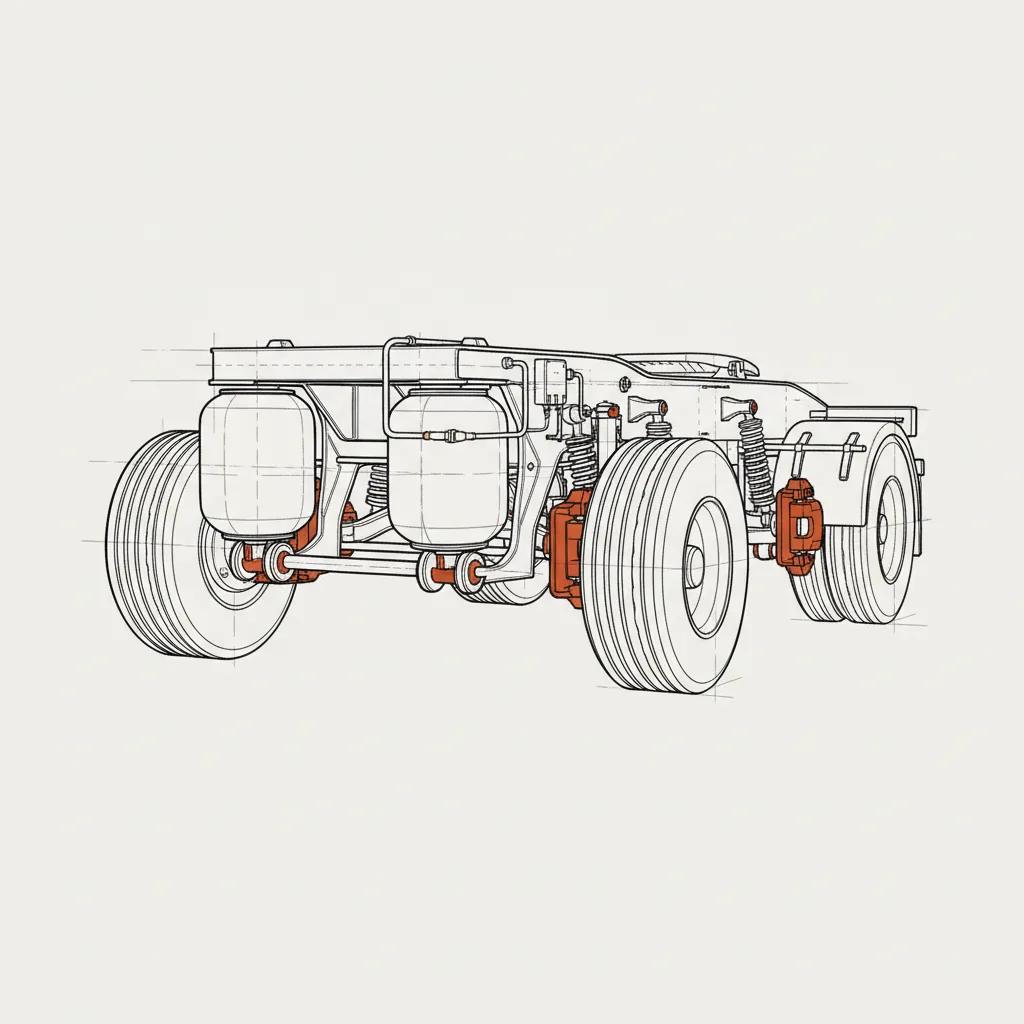
On a trailer with an automatic dump valve, air bags that settle to different heights once the parking brake is set are expected — the valve exhausts the springs by design. Aired up on level ground, though, the trailer should sit level: 49 CFR 393.207(f) requires the vehicle be level, not tilting to the left or right, with air leakage no greater than 3 psi in 5 minutes. A typical tandem-axle semi-trailer runs one height control valve for the whole trailer, so a persistent lean points at a leaking air spring, a height control valve that is not adding air, worn linkage, or a bent hanger.
Getting this right matters for more than comfort. Air suspension keeps the load level, protects freight, keeps the trailer at the correct deck height for loading docks, and shares braking and tracking forces evenly across the axles. When it fails, you risk cargo damage, uneven tire wear, and brake and alignment problems that can turn into a roadside violation.
How trailer air suspension works
A trailer air suspension system replaces steel leaf springs with rubber air springs (commonly called air bags or air ride bags) mounted between the axle and the frame. Compressed air from the tractor's supply feeds the bags through the trailer's air system.
The key parts most likely to need attention:
- Air springs (air bags): flexible rubber bellows that carry the load and absorb road shock.
- Height control valve (leveling valve): senses ride height and adds or releases air to keep the trailer level as the load changes.
- Shock absorbers: dampen bounce so the bags don't oscillate.
- Air lines, fittings, and the supply/pressure protection valve: route and regulate the air.
- Hangers, bushings, and U-bolts: the mechanical mounting that holds the axle in position.
Because these parts work together, a single failure can mimic several others. That's why diagnosis starts with finding the actual leak or fault, not just swapping parts.
Common trailer air suspension problems and their causes
Trailer sits low, leans, or won't air up
If one corner or side sits noticeably lower, the most common causes are a ruptured or leaking air spring on that side, or a height control valve that isn't adding air. Air springs crack from age, dry rot, road debris, and rubbing against a frame member or a misrouted line. A trailer that won't raise to ride height at all often points to a supply problem, a stuck height control valve, or a large leak.
Air leaks and the system won't hold pressure
Constant air loss, a system that cycles repeatedly, or a trailer that drops to the bump stops after sitting overnight usually means a leak. Likely sources are a porous or split air bag, loose or cracked fittings, chafed air lines, or a leaking height control valve. A soapy-water spray test at fittings and bags is the standard way to pinpoint small leaks. Persistent leaks also overwork the tractor's air compressor and can affect the air brake system, so they shouldn't be ignored.
Harsh or bouncy ride
A ride that feels harsh, bouncy, or floaty even with the bags holding air often points to worn shock absorbers. Failed shocks let the air springs keep oscillating after a bump. Leaking shocks (visible oil film) or shocks with worn mounting bushings should be replaced in pairs across an axle.
Uneven or premature tire wear
When the suspension can't hold the axle square and at the right height, tires scrub. Worn bushings, loose U-bolts, a bent torque arm, or a ride height that's set wrong all change axle alignment and accelerate tire wear. If you're replacing tires more often on a trailer than the tractor, the suspension and alignment are worth a close look.
Stuck or misadjusted height control valve
The height control valve is a frequent culprit because it constantly works. If it sticks open, the system overfills and the trailer rides too high; if it sticks closed or its linkage is bent, the trailer rides low and won't level. The linkage arm is exposed and easy to bend on debris or a curb.
How trailer air suspension repair is done
A methodical trailer suspension repair follows the same general path whether it's done in a shop or on-site:
1. Verify the complaint and inspect at ride height. A technician checks how the trailer sits, listens and feels for leaks, and confirms the system can build and hold air. 2. Pinpoint the leak or fault. Soapy water finds bag and fitting leaks; the height control valve and linkage are checked for sticking and correct adjustment. 3. Inspect the mechanical parts. Hangers, bushings, U-bolts, torque arms, and shock mounts are checked for cracks, looseness, and wear. 4. Replace the failed components. Ruptured air bags, leaking shocks, bad valves, and chafed lines are replaced. Shocks are typically done in pairs. 5. Reset and confirm ride height. The height control valve is adjusted to the manufacturer's ride height spec, then the system is re-checked for leaks and correct leveling under load.
Setting ride height to the manufacturer's specification is the step that's easiest to skip and most important to get right. Incorrect ride height changes geometry, affects brake timing, and wears tires even after good parts are installed.
Because an air-suspension failure can leave a trailer stuck and a load undeliverable, this is often handled with trailer suspension repair brought to the truck rather than towing the trailer in. Air bag and shock replacement, leak repair, and height-valve adjustment can frequently be done on-site.
Preventing air suspension failures
You can't stop rubber from aging, but routine attention catches most problems before they strand you:
- Walk the suspension during pre-trip: look for sagging corners, cracked bags, and oil-wet shocks.
- Listen for air leaks with the system charged and the trailer parked.
- Keep air lines from chafing against the frame and clear of the height-valve linkage.
- Check U-bolt and hanger hardware for looseness, especially after curb strikes.
- Address small leaks early, before they grow into a bag rupture or overwork the compressor.
Catching a weeping fitting or a bent leveling arm during a pre-trip is far cheaper than a roadside bag failure under load.
FAQ
What are the signs of a bad trailer air bag?
The trailer sits low or leans toward the failed corner, the air system cycles or leaks down when parked, and you may hear hissing near the bag. A cracked, split, or dry-rotted bag visible on inspection confirms it.
Why does my trailer keep losing air overnight?
The most common causes are a leaking air spring, loose or cracked air-line fittings, or a leaking height control valve. A soapy-water leak test at the bags and fittings is the standard way to find the source.
Can a trailer air suspension be repaired on the road?
Often yes. Air bag replacement, shock replacement, leak repair, and height control valve adjustment are commonly done on-site by mobile technicians, which can avoid towing the trailer to a shop.
Is it safe to drive with a leaking air suspension?
It's risky. A leaking suspension can drop the trailer onto the bump stops, throw the load off level, accelerate tire wear, and overwork the air system that also feeds the brakes. It should be diagnosed and repaired promptly.
How is correct trailer ride height set?
A technician adjusts the height control valve and its linkage to the trailer manufacturer's specified ride height, then confirms the trailer levels correctly and holds air under load.
Get trailer suspension help across Sacramento and Northern California
If your trailer is sagging, leaking air, or riding rough, 916 Truck Repair provides mobile, on-site trailer suspension repair throughout the Sacramento metro and Northern California, including the I-5, I-80, CA-99, and US-50 corridors and cities like Elk Grove, Stockton, Davis, Woodland, Roseville, and Auburn. Call (916) 898-9090 for 24/7 mobile dispatch.
 By Vladimir Sardari · Owner & Lead Technician