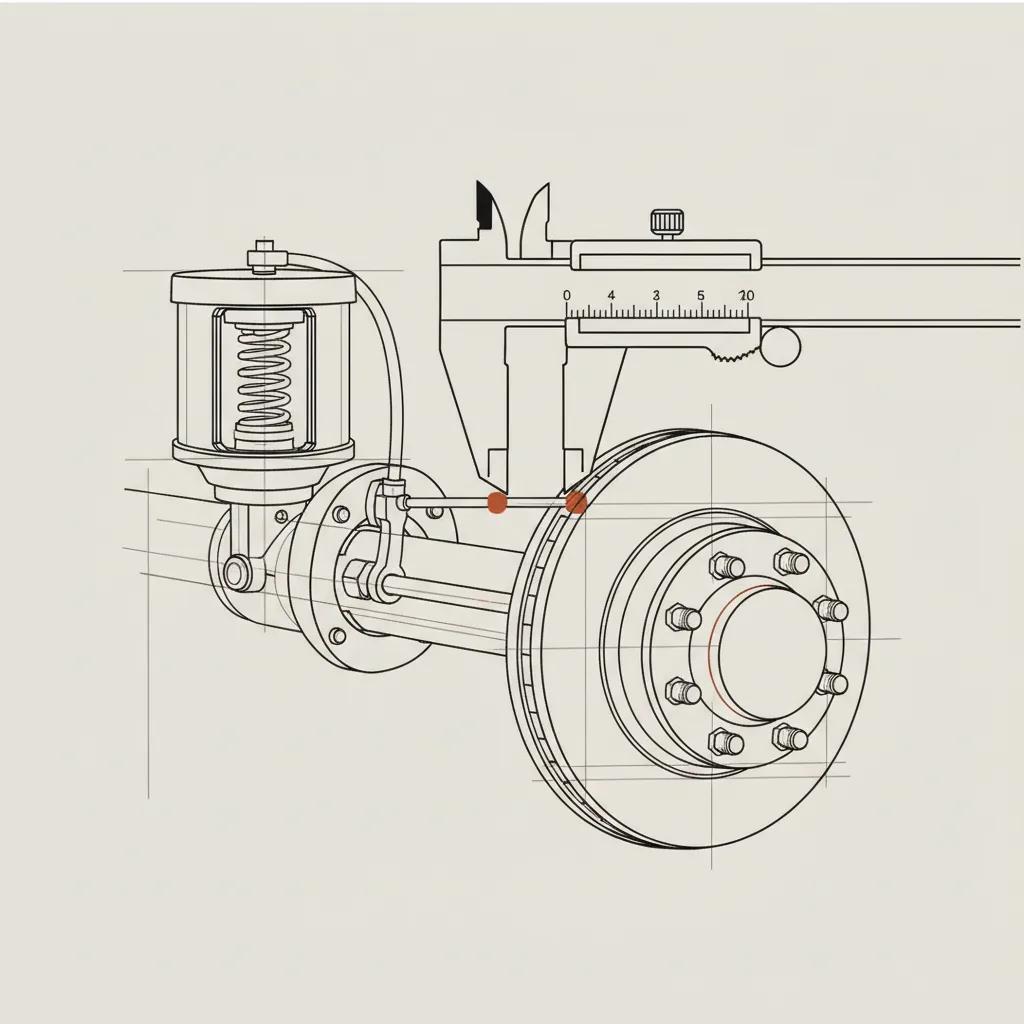
A commercial truck is placed out of service for air brake violations when its defects meet the North American Standard Out-of-Service Criteria published by the Commercial Vehicle Safety Alliance (CVSA) and enforced under Federal Motor Carrier Safety Administration (FMCSA) rules. The single most cited threshold is the 20% rule: if 20% or more of a vehicle's brakes are defective, the unit is declared out of service and cannot move until repairs are made. Individual defects such as audible air leaks, brakes out of adjustment beyond the readjustment limit, or a missing brake component can also trigger an out-of-service order on their own.
For owner-operators and fleet managers running the Sacramento metro and the I-5, I-80, CA-99, and US-50 corridors, an out-of-service order means a stalled load, lost revenue, and a violation on your CSA record. Understanding exactly what inspectors look at is the difference between rolling through a weigh station and waiting on the shoulder for a repair.
What "Out of Service" Actually Means
An out-of-service (OOS) order is a formal determination by a certified inspector that a vehicle, driver, or load is unsafe to operate. The truck is legally prohibited from moving until the defect is corrected. According to the FMCSA, out-of-service conditions for the vehicle are defined by the CVSA's North American Standard Out-of-Service Criteria, which is the same standard used across the United States, Canada, and Mexico.
Air brake violations are consistently among the most common reasons commercial vehicles are placed out of service during roadside inspections, which is why the brake system is a primary focus of Level I and Level IV DOT inspections.
The 20% Rule for Defective Brakes
The most important concept in air brake out-of-service criteria is the 20% defective brake calculation. Under the CVSA criteria, a vehicle is placed out of service when the number of defective brakes equals or exceeds 20% of the total service brakes on the vehicle or combination.
- On a typical 5-axle tractor-trailer with 10 brakes, that means 2 defective brakes (20%) puts the combination out of service.
- The count is taken across the entire combination, not per-unit, so a tractor and trailer are evaluated together.
- A "defective brake" includes brakes out of adjustment beyond the limit, brakes with mismatched air chamber sizes, missing or broken mechanical components, and contaminated linings.
This is why a single neglected slack adjuster or one leaking chamber can be enough to take you off the road when combined with another marginal brake.
Brakes Out of Adjustment
Pushrod travel that exceeds the manufacturer's readjustment limit counts as a defective brake. Inspectors measure the stroke of the pushrod at a set air pressure and compare it to the limit for that chamber and slack adjuster type. Brakes drift out of adjustment as linings wear, so the same truck that passed last month can fail today if adjustments have been skipped.
Defects That Are Out of Service on Their Own
Some air brake conditions place a vehicle out of service regardless of the 20% calculation. These individual "automatic" violations include:
- Audible air leaks at a chamber, hose, or fitting that you can hear, or air loss that the system cannot keep up with.
- Air loss rate that exceeds allowable limits, indicating the compressor cannot maintain pressure under demand.
- Low air warning device that does not work, since the driver loses the early warning of pressure loss.
- Inoperative or missing required brakes, including a brake that does not apply or release.
- Cracked, broken, or missing brake drums or rotors beyond the allowable damage.
- Worn linings or pads below the minimum thickness, or linings contaminated with oil or grease.
- Damaged or frayed hoses and tubing with the inner reinforcement ply exposed, or hoses that bulge under pressure.
- Mismatched air chambers or slack adjuster lengths on the same axle, which create uneven braking.
How Inspectors Check Air Brakes at the Roadside
A Level I inspection is the most thorough and includes a full brake check, often under the vehicle. The inspector typically:
- Builds system air pressure and checks the governor cut-in and cut-out behavior.
- Listens and tests for air leaks with the brakes applied.
- Verifies the low-air warning activates at the correct pressure.
- Measures pushrod stroke against the readjustment limit on each wheel.
- Inspects drums, rotors, linings, chambers, hoses, and the ABS system.
- Checks that the ABS malfunction lamp works and goes out as required.
Many weigh stations across Northern California, including those on the I-80 and I-5 corridors, run these inspections, and performance-based brake testers are increasingly used to measure actual braking force.
How to Avoid an Air Brake Out-of-Service Order
Most air brake violations are preventable with consistent maintenance and a thorough pre-trip. Practical steps that keep you in service:
- Do a real air brake pre-trip. Check for leaks, test the low-air warning, confirm the governor cuts out, and do a static and applied leakage test.
- Watch your slack adjusters. Listen for and feel excessive pushrod travel; manual slack adjusters need periodic attention and automatic ones can still fail.
- Inspect linings, drums, and chambers at every service interval, and replace components before they reach the minimum.
- Fix small leaks immediately. An audible leak that seems minor at the yard can become an out-of-service citation at a scale.
- Keep ABS lamps working. A burned-out or constantly lit ABS warning lamp is an easy violation to catch and an easy one to prevent.
When a defect does turn up, getting it corrected on-site keeps the load moving. A mobile air brake repair service can address leaks, adjustment, and component replacement where the truck sits, and a pre-inspection DOT brake inspection can catch problems before an enforcement officer does.
Cost Factors When Air Brake Repairs Are Needed
The cost of clearing an air brake out-of-service condition depends on what failed. The main factors are:
- Which component is defective (a leaking fitting versus a failed chamber, drum, or compressor).
- How many wheel ends are affected, since a 20%-rule failure usually means more than one.
- Parts availability for your make and model.
- Whether the repair is done on-site or the truck must be towed to a shop.
Because an OOS order stops the truck where it is, on-site repair is often the fastest path back into service.
FAQ
What percentage of defective brakes puts a truck out of service?
Under the CVSA North American Standard Out-of-Service Criteria enforced by FMCSA, a vehicle or combination is placed out of service when 20% or more of its service brakes are defective. On a 10-brake tractor-trailer, that is two defective brakes.
Can a single air leak cause an out-of-service order?
Yes. An audible air leak at a chamber, hose, or fitting, or an air loss rate the system cannot keep up with, is an out-of-service condition on its own, separate from the 20% calculation.
Do brakes out of adjustment count as defective?
Yes. A brake with pushrod travel beyond the manufacturer's readjustment limit is counted as a defective brake and contributes to the 20% out-of-service calculation.
How are air brakes checked during a DOT inspection?
In a Level I inspection, the inspector tests air pressure and the governor, checks for leaks, verifies the low-air warning, measures pushrod stroke at each wheel, and inspects drums, linings, hoses, chambers, and the ABS system.
What should I do if my truck is placed out of service for brakes?
The truck cannot move until the defect is repaired. Arrange repair where the vehicle is located, then have the corrected items verified so you can return to service without compounding the violation.
Get Back in Service Fast
If an air brake defect has stopped your truck, or you want a brake check before your next scale crossing, 916 Truck Repair offers mobile, on-site service across the Sacramento metro and Northern California, including the I-5, I-80, CA-99, and US-50 corridors and cities like Elk Grove, Stockton, Davis, Woodland, Roseville, and Auburn. Call (916) 898-9090 for 24/7 mobile dispatch and on-site roadside truck repair.
 By Vladimir Sardari · Owner & Lead Technician