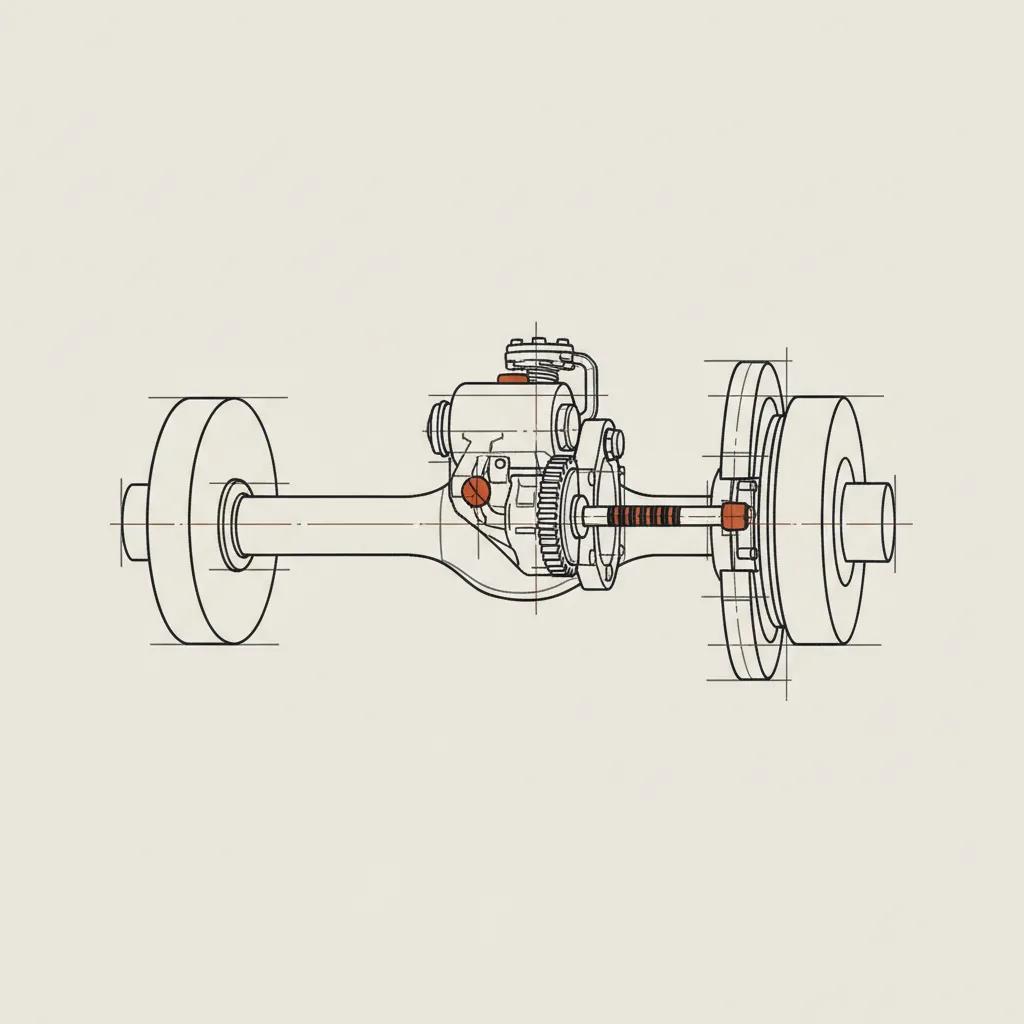
The clearest signs your slack adjusters are out of adjustment are an over-stroked brake chamber push rod, a longer or softer brake pedal, weaker stopping power, uneven brake wear or temperature across axles, and the truck pulling to one side under braking. The most reliable single check is measuring applied push-rod stroke against the brake chamber's limit — a stroke at or beyond it means the slack adjuster, foundation brake, or both need attention. Catching this early protects your stopping distance and your inspection record.
A slack adjuster is the lever connecting the brake chamber push rod to the camshaft (the S-cam) on each air-brake foundation. When you apply the brakes, the push rod extends, the slack adjuster rotates the S-cam, and the cam spreads the shoes against the drum. As the linings wear, the push rod travels farther to make the shoes touch. Modern automatic slack adjusters take up that slack on their own — but they wear, seize, and fall out of adjustment, and when they do your brakes quietly lose effectiveness. Knowing the symptoms helps you decide whether to keep rolling, schedule service, or call for air brake repair before a roadside inspection finds it first.
The Most Common Signs of Slack Adjuster Adjustment Problems
Slack adjuster trouble rarely shows up as one obvious failure. It builds gradually as stroke creeps longer, and the symptoms overlap with worn linings and air supply issues — so it helps to read them together.
Excessive push-rod stroke
The single most important indicator is how far the brake chamber push rod travels when the brakes are applied. The Federal Motor Carrier Safety Administration's North American Standard Out-of-Service Criteria define a maximum applied stroke for each brake chamber size and type, and a brake at or beyond that limit is an adjustment defect. As linings wear and slack increases, stroke lengthens — and a slack adjuster that has stopped doing its job lets it run past the limit. Measuring stroke at each wheel is the only way to confirm adjustment objectively rather than by feel.
Longer or softer brake pedal and slower response
When one or more brakes are out of adjustment, more push-rod travel is consumed before the shoes contact the drums. From the cab that feels like a longer brake treadle, a softer application, and a delay before the truck starts slowing. Stopping distances stretch, and it takes more pedal to do what it used to do with less.
Uneven brake wear, heat, or pulling
If one slack adjuster is out and the others are correct, that wheel does less of the braking work and the rest pick up the slack:
- The truck may pull or veer to one side under hard braking as force becomes unbalanced.
- Linings and drums wear unevenly from axle to axle or side to side.
- An under-working brake runs cooler while the compensating brakes run hotter — a temperature difference you can sometimes feel or measure after a stop.
Visible clues at the slack adjuster itself
A pre-trip walkaround can reveal a lot. At full application, the angle between the push rod and the slack adjuster arm should be close to 90 degrees. Arms and push rods that don't move freely, move different amounts on the same axle, or show a clearly different angle than the others are warning signs. An automatic unit recently "adjusted" by hand is a red flag — these should not need routine manual adjustment, and doing so often hides the real problem.
Why Slack Adjusters Fall Out of Adjustment
Understanding the root cause helps you avoid a repeat. The adjustment defect you measure is usually a symptom of something underneath it.
Worn or seized automatic slack adjusters
Automatic slack adjusters contain an internal clutch and gear mechanism that takes up slack a little at a time. Corrosion, contamination, missed lubrication, and wear can cause that mechanism to slip or seize, so it stops compensating for lining wear. Once it stops adjusting, stroke marches past the limit no matter how good the rest of the brake is — and many of these units have a grease fitting whose skipped service interval is a leading reason they fail.
Worn foundation parts or mismatched components
The slack adjuster is only one part of the system. Worn linings, scored drums, and cracked or loose S-cam bushings all increase the travel needed to apply the brakes — a worn S-cam bushing in particular lets the cam move where it shouldn't, eating up stroke. So do installation errors: the wrong slack adjuster length, an incorrect angle, a mismatched chamber size, or mixed component sizes across an axle will read as an adjustment problem from day one.
Why This Matters for Safety and Compliance
Out-of-adjustment brakes are not a minor housekeeping item. Brake systems consistently rank among the most common categories of vehicle violations theFMCSArecords during roadside inspections, and brake adjustment is a frequent defect within that group. The agency's out-of-service criteria also use a 20-percent rule: if defective brakes — including those beyond the adjustment limit — equal 20 percent or more of the vehicle's service brakes, it can be placed out of service.
That has two practical consequences for owner-operators and fleets:
- Safety: Every out-of-adjustment brake lengthens stopping distance and shifts load onto the brakes that still work, which can overheat them on a long grade like the I-80 climb toward the Sierra.
- CSA and downtime: A brake-adjustment violation hurts your CSA Vehicle Maintenance score, and an out-of-service order strands the truck until it's fixed.
A proper DOT brake inspection measures stroke at every wheel and catches these defects before an inspector — or a panic stop — does.
How to Check and What to Do
You can do a basic check yourself, but correcting adjustment is foundation-brake work.
A simple stroke check
With the truck safely chocked and air pressure built up, have someone make a firm brake application and hold it while you measure how far each push rod extends from released to applied. Chalk on the push rod makes the travel easy to see. Compare each measurement to the maximum stroke for that chamber size and type; any wheel at or beyond its limit is out of adjustment.
Don't just re-adjust an automatic unit
If an automatic slack adjuster is out, the answer usually isn't to crank it back manually — that masks the underlying fault and the stroke drifts right back out. The unit and foundation brake need to be inspected to find why it stopped self-adjusting: a seized mechanism, a worn S-cam bushing, missing lubrication, or worn linings. Fixing the cause keeps the correction from disappearing on the next trip.
What drives the cost of the repair
We don't quote a flat price because several factors move the number:
- Whether the fix is lubrication and adjustment or full slack adjuster replacement
- How many wheel ends are affected, and whether foundation parts (linings, drums, S-cam bushings, chambers) also need work
- The truck and trailer configuration, and whether the repair is on-site or requires a tow
Because slack adjusters are part of the air-brake foundation, it's smart to address them within a full brake check so an imbalance or worn component doesn't undo the adjustment.
FAQ
How do I know if my slack adjusters are out of adjustment?
Measure the brake chamber push-rod stroke at each wheel during a firm application and compare it to the maximum for that chamber size. A stroke at or beyond the limit means the brake is out of adjustment. Supporting signs include a longer or softer pedal, weaker braking, uneven wear, and the truck pulling to one side under braking.
Can I drive with a slack adjuster out of adjustment?
It depends on severity. One slightly long stroke increases stopping distance and should be fixed promptly; multiple out-of-adjustment brakes can place the vehicle out of service under FMCSA criteria. If braking feels weak or the truck pulls hard under braking, get it inspected before the next loaded run.
Should I manually adjust an automatic slack adjuster?
Generally no. Automatic units are designed to self-adjust and should not need routine manual adjustment. Re-adjusting one by hand usually hides a seized mechanism or worn foundation brake, and the problem returns. The unit and brake should be inspected to find the root cause.
What is the maximum brake push-rod stroke?
There is no single number — the FMCSA out-of-service criteria specify a maximum applied stroke based on the brake chamber's size and type. A brake at or beyond that published limit is out of adjustment, which is why the chamber type has to be identified before judging the measurement.
Do slack adjuster problems cause CSA violations?
Yes. Brake adjustment is a common defect found during roadside inspections, and brake-related violations affect a carrier's CSA Vehicle Maintenance score. Brakes beyond the adjustment limit also count toward the 20-percent threshold that can put a vehicle out of service.
Get Your Brakes Checked Before an Inspector Does
If your brake pedal feels long, your truck pulls under braking, or you suspect a slack adjuster is out of adjustment, call 916 Truck Repair at (916) 898-9090 for 24/7 mobile dispatch. We come to you — yard, rest area, or roadside — across the Sacramento metro and the I-5, I-80, CA-99, and US-50 corridors to measure stroke, find the root cause, and get your air brakes back in spec before your next loaded run.
 By Vladimir Sardari · Owner & Lead Technician