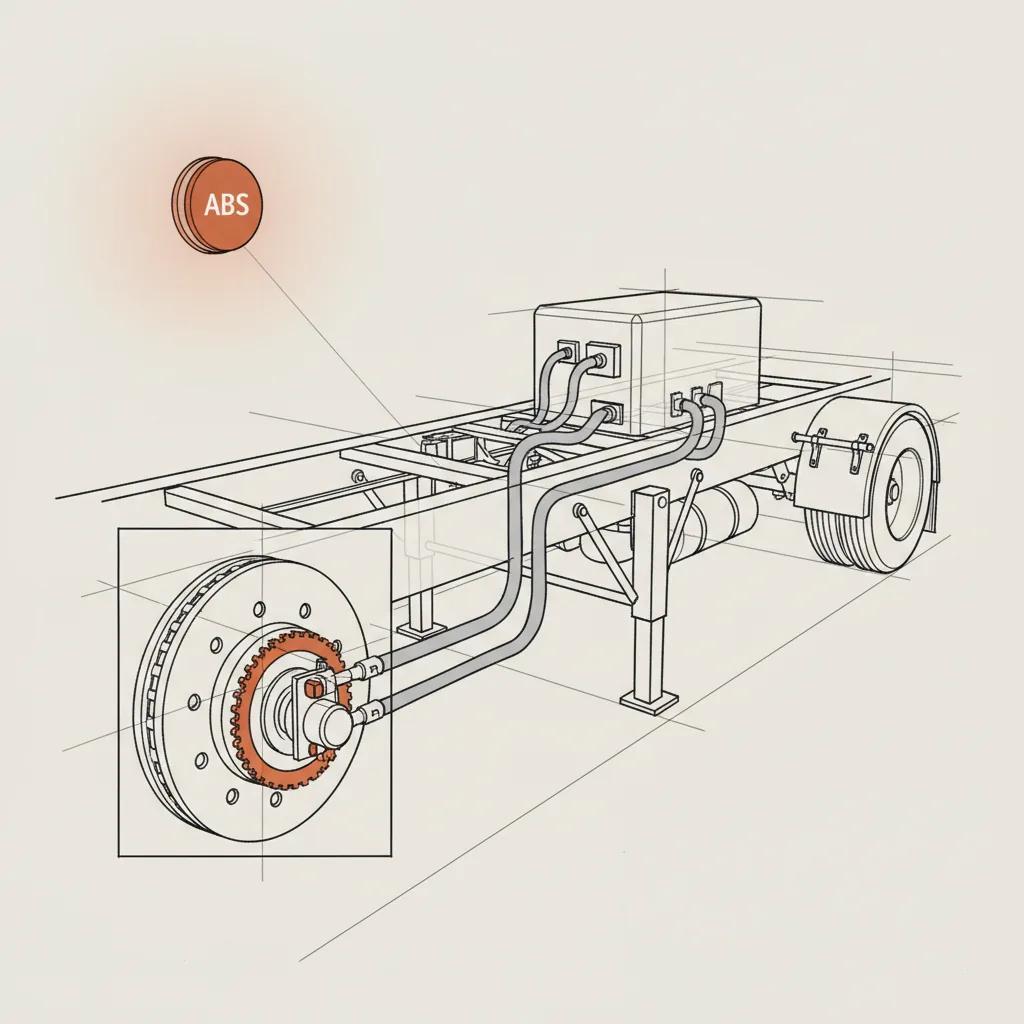
A trailer ABS light that stays on means the trailer's anti-lock braking system has detected a fault and shut ABS off for the affected wheels. The base brakes still work, but you lose anti-lock protection during hard or slippery stops until the fault is fixed. The most common triggers are wheel-speed sensor problems, damaged sensor wiring, a bad ABS power connection through the trailer cord, or a fault inside the ABS modulator valve.
The yellow ABS lamp on the side of the trailer is the standard indicator required on air-braked trailers built after the late 1990s. When you start the truck, that lamp should light briefly and then go out once the system finishes its self-check. If it stays lit while you drive, the system is telling you it found a problem and is no longer controlling that wheel or axle.
What a Trailer ABS Light Actually Tells You
The trailer ABS light is the trailer's way of reporting a stored fault. Inside the trailer, an ABS electronic control unit (ECU) watches wheel-speed sensors and pulses the brakes to prevent lockup. When it sees a signal it can't trust, an out-of-range reading, or a circuit that's open or shorted, it sets a code, turns the lamp on, and disables ABS function on at least part of the trailer.
A few important points for owner-operators and dispatchers:
- The light means ABS is partly or fully disabled, not that the brakes have failed. Your service brakes still apply.
- ABS reduces wheel lockup and jackknife risk in panic stops and on wet or icy surfaces. Losing it raises your risk exactly when stopping distance matters most.
- The fault is stored in the trailer ECU, so it usually needs a diagnostic scan tool to read the code, not just a visual guess.
- A trailer ABS lamp that does not light at all at startup can also be a violation, because the bulb or circuit may be dead.
Newer trailers send ABS status to the tractor dash over the power line, so some drivers see a dash indicator too. Either way, the message is the same: get the system diagnosed.
Common Causes of a Lit Trailer ABS Light
Most trailer ABS faults trace back to a short list of culprits. Working from most to least common helps you and your technician narrow it down faster.
Wheel-Speed Sensor Problems
The wheel-speed sensors are the parts most exposed to road abuse, so they fail most often.
- A sensor backs out of its mounting bushing and loses its air gap to the tone (exciter) ring, so the signal drops out.
- The tone ring is rusted, cracked, or has missing teeth, producing an erratic reading.
- Brake heat, water, and salt corrode the sensor or connector over time.
- A sensor reads fine sitting still but faults at speed, which is why intermittent ABS lights are common.
Wiring and Connector Damage
Trailer wiring lives a hard life under the deck and around the suspension.
- Chafed or pinched harnesses where wires rub against the frame or air lines.
- Corroded pins inside sensor connectors or the main ABS connector.
- Damage from road debris, curbing, or a dropped trailer.
Power and Ground Through the Trailer Cord
Many ABS faults are really power problems coming from the tractor.
- A corroded or bent pin in the seven-way trailer cord (the ABS power runs on the blue/center auxiliary circuit on standard J560 plugs).
- A worn trailer cord or socket that loses contact when the rig flexes.
- Low or interrupted voltage that the ABS ECU reports as a fault.
ABS Modulator Valve or ECU Faults
Less often, the problem is in the ABS hardware itself.
- A modulator (relay) valve that sticks or fails its internal self-test.
- An internal ECU fault, sometimes after water intrusion.
- Stored historical codes that were never cleared after an earlier repair.
What to Check When the Light Comes On
You can do a few safe checks roadside before calling for trailer ABS repair, but treat the ABS system as a safety item and don't keep running a trailer with a known active fault.
- Confirm the symptom: does the lamp light at startup and stay on, or never light at all? Both point to a real issue.
- Inspect the trailer cord and both ends of the seven-way connector for corrosion, bent pins, and moisture. Clean and reseat it.
- Look for obvious wiring damage near the axles, suspension, and air lines.
- Check that wheel-speed sensors look seated and that harnesses aren't hanging or chafed.
- Note whether the light is steady or intermittent and whether it changes when you switch trailers, which helps a technician tell a tractor problem from a trailer problem.
For the actual repair, a technician will hook up a scan tool that reads the trailer ABS ECU, pull the stored codes, and measure the suspect circuit. Reading the code is what separates a quick sensor reseat from a deeper wiring or valve repair. Trailer ABS diagnostics overlap heavily with general air brake repair, since the modulator valves are plumbed into the same air system.
Can You Keep Driving With the ABS Light On?
Mechanically, the trailer will still stop because the base air brakes are independent of ABS. But that doesn't make it a non-issue. You're driving without anti-lock protection, and you're carrying a defect that an inspector can find.
Under Federal Motor Carrier Safety Administration (FMCSA) rules, ABS is required equipment on air-braked trailers manufactured after the federal effective dates, and the malfunction lamp must work. A trailer ABS that is inoperative or has a malfunction indicator that won't go out can be cited during a roadside inspection or DOT inspection. That can mean a CSA violation on your record and, in some cases, the unit being placed out of service.
The practical takeaway: a steady trailer ABS light is a repair to schedule now, not a warning to ignore until your next maintenance interval.
Cost Factors for Trailer ABS Repair
There's no single price for fixing a trailer ABS light because the fault can be anything from a loose connector to a failed valve. The factors that move the cost include:
- Whether the fix is a sensor and bushing, a wiring repair, or a modulator valve or ECU replacement.
- How many axles and sensors the trailer has (two-sensor versus four-sensor or six-sensor layouts).
- Diagnostic time, since intermittent faults take longer to confirm.
- Parts availability for the specific ABS brand on your trailer.
- Whether the work is done on-site or the trailer has to be moved.
A mobile diagnosis usually costs less in total downtime than towing a loaded trailer to a shop, since the technician brings the scan tool and common parts to you.
FAQ
Is it safe to drive with the trailer ABS light on?
The trailer will still brake because the base air brakes work independently, but you've lost anti-lock protection and you're carrying a defect that can be cited at a DOT inspection. Get it diagnosed promptly rather than driving on it indefinitely.
Why does my trailer ABS light come on only sometimes?
Intermittent ABS lights usually point to a wheel-speed sensor with a marginal air gap, a chafed wire, or a corroded connector that loses contact when the rig flexes or warms up. The fault is real even if the light isn't always on.
Will a trailer ABS fault fail a DOT inspection?
It can. FMCSA requires working ABS and a functioning malfunction lamp on air-braked trailers built after the federal effective dates. An inoperative system or a lamp that won't go out can result in a violation and possibly an out-of-service order.
Can a bad trailer cord cause the ABS light?
Yes. ABS power runs through the seven-way trailer connector, so a corroded pin, worn socket, or damaged cord can interrupt power to the ABS ECU and set a fault. Cleaning and reseating the connector is one of the first things to check.
Do I need a scan tool to fix the trailer ABS light?
In most cases, yes. The fault code is stored in the trailer ABS ECU, and reading it with a scan tool tells you which sensor or circuit is involved instead of guessing. A technician can then verify and clear the code after the repair.
If your trailer ABS light is on, 916 Truck Repair provides mobile diagnostics and repair across the Sacramento metro and Northern California, including the I-5, I-80, CA-99, and US-50 corridors and cities like Elk Grove, Stockton, Davis, Woodland, Roseville, and Auburn. Call (916) 898-9090 for 24/7 mobile dispatch and get the trailer back in service safely.
 By Vladimir Sardari · Owner & Lead Technician