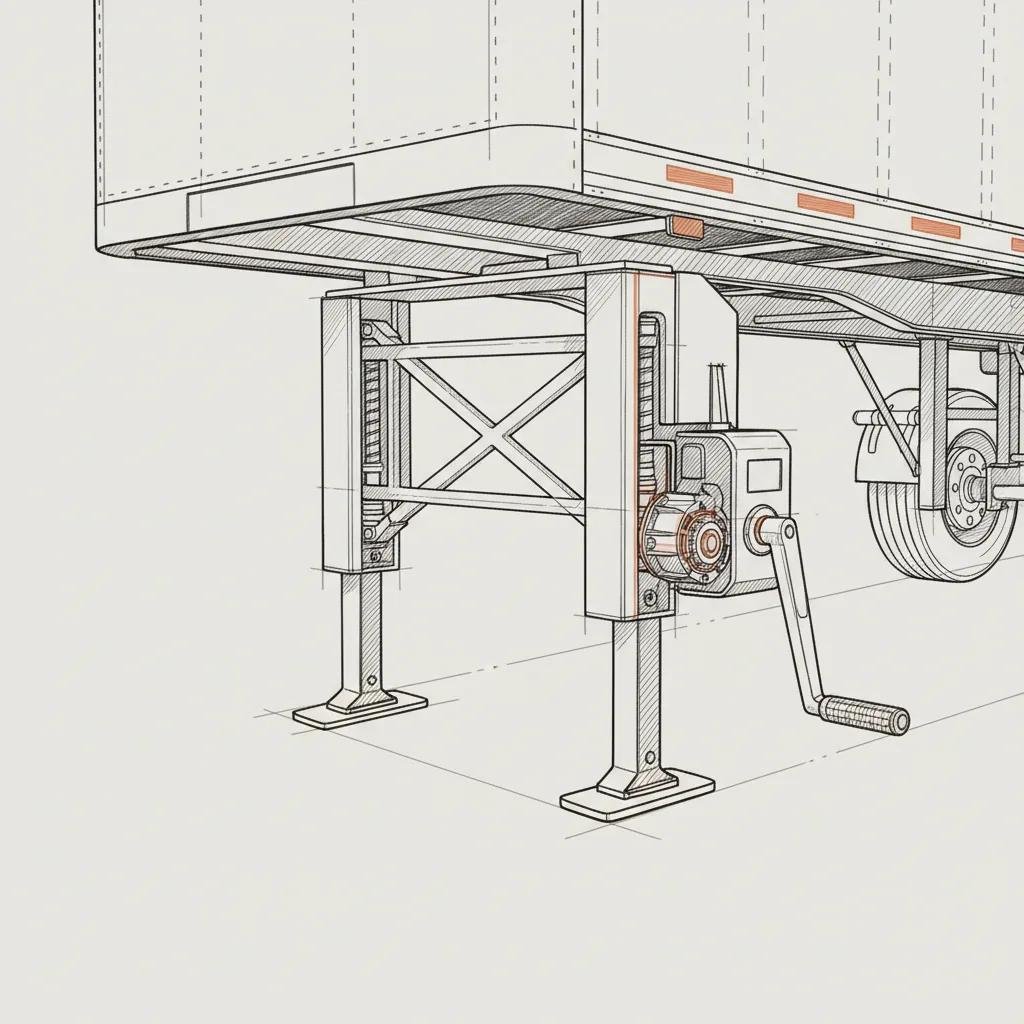
Trailer landing gear needs repair when the crank becomes hard to turn, the legs no longer raise or lower evenly, the gearbox grinds or slips, or a leg shows visible bending, cracks, or a broken foot pad. Catch these symptoms early and you usually face a gearbox or leg-section fix; ignore them and you risk a trailer dropping in the yard, a damaged kingpin, or an unsafe coupling. Below is how to read the signs, what causes them, and how the repair is approached.
What trailer landing gear does and why it fails
Landing gear (also called trailer legs or dollies) is the two-legged support that holds the front of a semi-trailer level when it's uncoupled from the tractor. A hand crank drives a gearbox, which turns internal screws inside each leg to raise and lower the trailer. A low gear gives you the mechanical advantage to lift a loaded trailer; a high gear lets you spin the legs up or down quickly once the weight is off them.
Because the gear sits low on the trailer and gets cranked thousands of times over its life, it wears and takes abuse. The most common reasons it fails:
- Dirt, road salt, and water working past worn seals into the gearbox and screw threads
- Lack of grease on the internal screw, bevel gears, and pinion
- Dropping the trailer too hard or coupling at the wrong height, which shock-loads the legs
- Cranking in the wrong (low) gear under speed, which strips teeth
- Curb strikes and yard impacts that bend a leg or shear a foot pad
- Corrosion that seizes the screw so the leg won't extend or retract
The Federal Motor Carrier Safety Administration's cargo securement and vehicle inspection rules treat the trailer's support and coupling system as safety-critical, so worn landing gear isn't just an inconvenience. A leg that collapses under a loaded trailer can injure people and damage the trailer structure.
Warning signs your trailer landing gear needs repair
Most landing gear problems announce themselves at the crank handle or in how the trailer sits. Watch for these.
Hard or notchy cranking
If the handle suddenly takes far more effort than usual, the internal screw is likely dry, contaminated, or starting to corrode. A gritty or notchy feel as you turn often means worn bevel gears or debris in the gearbox. Don't force it with a cheater bar; that's how teeth get stripped and shafts get bent.
The trailer leans or one leg lags
Landing gear legs are linked by a cross shaft so both rise and lower together. If the trailer leans to one side, the cross shaft, a coupling pin, or one leg's internal screw has failed and the legs are no longer synchronized. A leaning trailer puts uneven load on the kingpin and fifth wheel.
Grinding, slipping, or free-spinning crank
A grinding noise points to metal-on-metal contact from missing grease or chipped teeth. If the crank spins freely without raising the trailer, the gear teeth or the pinion have stripped and the gearbox is no longer transmitting force.
A leg won't fully retract or extend
A leg stuck partway up is a roadworthiness problem and a coupling hazard. Causes include a seized screw, a bent inner leg, or internal corrosion. A leg that won't extend fully can leave the trailer unstable when you drop it.
Visible damage
- Bent or buckled leg tubes
- Cracked welds where the legs mount to the trailer frame
- A broken, missing, or crushed foot/sand shoe
- A bent or seized crank handle
Any of these calls for inspection before the trailer is dropped again.
Repair, rebuild, or replace?
The right fix depends on what failed and how far the damage has spread.
Service and lubrication
If the legs still operate but cranking is stiff, the first step is cleaning and re-greasing the gearbox, cross shaft, and internal screws. Catching a dry gearbox early is the cheapest outcome and often restores smooth operation.
Gearbox or component repair
When the gearbox grinds, slips, or free-spins, the internal bevel gears and pinion are usually worn or stripped. Many landing gear designs allow the gearbox to be rebuilt or swapped without replacing the whole leg assembly. A bent cross shaft or sheared coupling pin is also a contained repair.
Full leg or assembly replacement
Bent leg tubes, cracked mounting welds, or a seized, corroded internal screw usually mean replacing the affected leg or the complete two-leg assembly. Cracked welds at the frame are structural and should be repaired by a technician, not patched in the field. Both legs are typically serviced together so they stay synchronized and wear evenly.
This kind of work overlaps with broader trailer repair, since landing gear problems often surface alongside suspension, wiring, or air-system issues during the same inspection.
How to make trailer landing gear last
You can't stop every impact, but routine care prevents most failures:
- Grease on schedule. Lubricate the gearbox, cross shaft, and screws per the manufacturer's interval, more often in winter and in salt or coastal conditions.
- Couple at the right height. Match trailer height to the fifth wheel so you're not shock-loading the legs.
- Crank in the correct gear. Use low gear to lift weight, high gear only when the legs are free of load.
- Raise the legs fully before driving. A partly lowered leg can catch on dock plates, ramps, or rough crossings.
- Inspect during pre-trips. Look for bent tubes, cracked welds, missing foot pads, and a crank handle that's hard to turn.
Drivers and dispatchers running the I-5, I-80, CA-99, and US-50 corridors around Sacramento see plenty of salt and grit kicked up in winter, which accelerates corrosion inside neglected gearboxes. A quick grease and inspection between loads is far cheaper than a roadside leg failure.
FAQ
Can I keep driving with damaged landing gear?
You can move a trailer with the legs fully retracted and locked, but you should not drop or park it on a leg that's bent, cracked, or won't extend fully. A failed support can let the trailer drop, damaging the trailer and creating a safety hazard. Have it inspected before the next uncoupling.
Why is my trailer landing gear so hard to crank?
The most common cause is a dry or contaminated gearbox and screw assembly. Dirt, water, and road salt work in past worn seals and the internal threads bind. Worn bevel gears can also create a notchy, hard-to-turn feel. Cleaning and re-greasing fixes many cases, but grinding or slipping usually means internal wear that needs repair.
Should both landing gear legs be replaced at once?
When a leg assembly is worn or damaged, technicians often service or replace both legs together. The legs are linked by a cross shaft and need to operate in sync; matching their condition keeps the trailer level and prevents the good leg from carrying uneven load.
Is a leaning trailer a landing gear problem?
It can be. If the trailer leans while parked on its legs, one leg may be lagging because of a failed internal screw, a bent leg, or a broken cross shaft pin. It's worth inspecting promptly, since uneven support stresses the kingpin and fifth wheel.
Get trailer landing gear inspected or repaired
If your landing gear is stiff, grinding, leaning, or won't fully raise, don't wait for it to drop a trailer. 916 Truck Repair offers mobile, on-site service across the Sacramento metro and Northern California. Call (916) 898-9090 for 24/7 dispatch.
 By Vladimir Sardari · Owner & Lead Technician