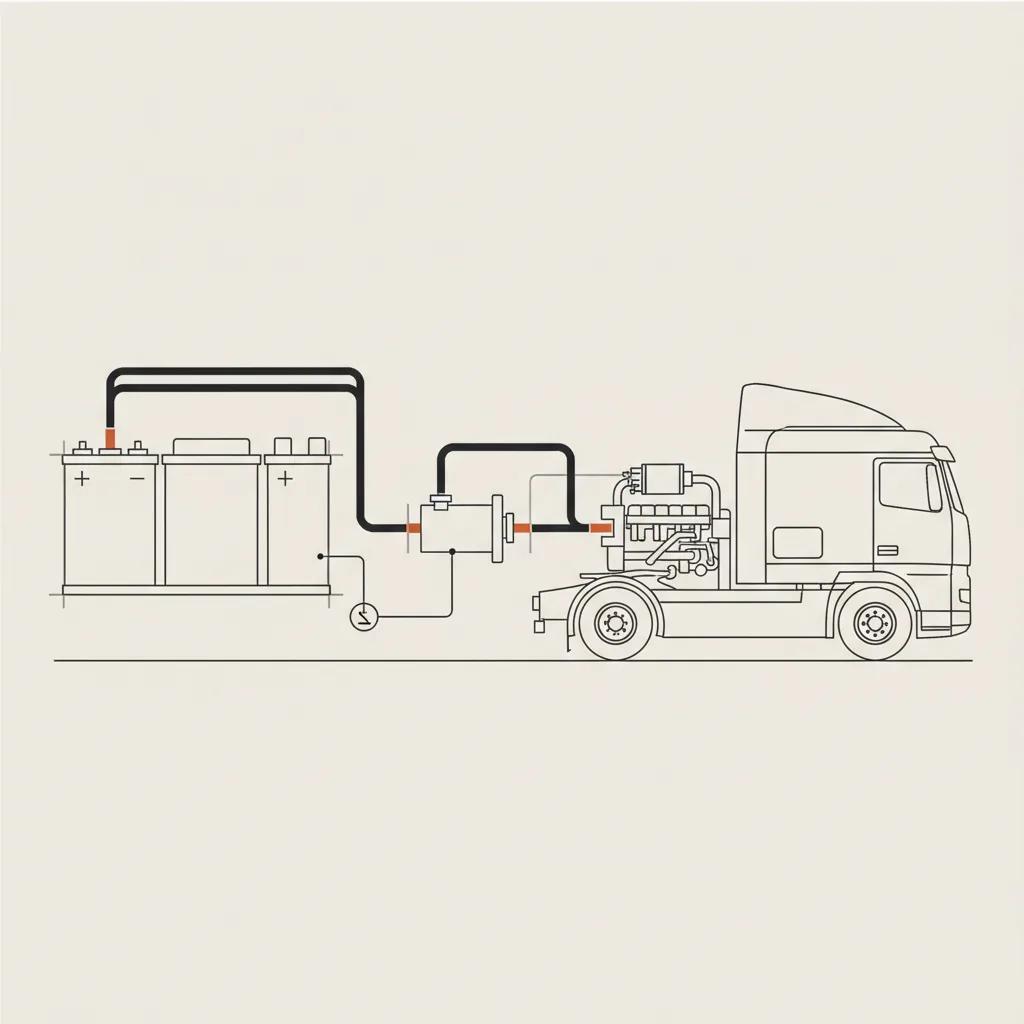
When a semi truck won't crank, the cause is electrical far more often than mechanical. A true "no crank" means you turn the key and the starter motor does not spin the engine at all. The most common reasons are weak or dead batteries, corroded or loose battery cables and ground straps, a failed starter or starter solenoid, and faults in the ignition switch, neutral safety circuit, or battery disconnect. Working through these in order usually finds the problem before a tow truck is needed.
Before you chase parts, it helps to separate a no-crank condition from a no-start. If the starter turns the engine over but it won't fire, that points toward fuel, air, or the diesel-specific systems covered in our hard-start guides. This article focuses on a truck that gives you nothing, a single click, or rapid clicking when you turn the key.
Start With the Batteries and Connections
Most no-crank calls on heavy trucks trace back to the batteries or the heavy cables feeding the starter. Class 8 trucks typically run multiple batteries wired in parallel to deliver the cranking amps a big diesel needs, so a single weak battery or one bad connection can drag the whole bank down.
Check Battery Voltage and State of Charge
With everything off, a healthy 12-volt system should read around 12.6 volts at rest. Anything in the low 12s or below usually means the batteries are discharged or aging. The more telling test happens during cranking: if voltage collapses well below 10 volts the moment you turn the key, the batteries can't hold up under load even if they show a decent resting number.
- Test each battery individually, not just the bank, so one bad cell doesn't hide behind the others.
- Look for swollen cases, leaking electrolyte, or a rotten-egg smell, which all point to a battery that should be replaced.
- Remember that cold weather sharply reduces available cranking power, so a marginal battery often fails first on a cold Sacramento Valley morning.
Inspect Cables, Terminals, and Ground Straps
Clean, tight connections matter as much as the batteries themselves. High resistance from corrosion or a loose clamp will starve the starter even when the batteries are fully charged.
- Check both ends of every battery cable, the main positive feed to the starter, and the ground straps from the batteries to the frame and engine block.
- Look for green or white corrosion, frayed strands, melted insulation, and clamps you can wiggle by hand.
- A bad engine-to-frame ground is a classic hidden cause: the dash lights work, but the starter has no clean return path, so it clicks or does nothing.
If cleaning and tightening restores cranking, you've likely found it. If you're stranded and the batteries are simply dead from lights or an APU left running, a proper heavy-duty jump start can get you rolling while you sort out the underlying cause.
Test the Starter and Solenoid
If the batteries and cables check out, the next suspect is the starter circuit. The sound the truck makes when you turn the key is a useful clue.
- Single loud click, no crank: often a stuck or failed starter solenoid, or the starter motor itself has failed internally.
- Rapid clicking: usually low voltage, the solenoid pulling in and dropping out because there isn't enough current.
- Nothing at all: points upstream to the control circuit, ignition switch, relay, or a blown fusible link rather than the starter.
How a Starter Fails
Starters wear out from heat, vibration, and thousands of cycles. Worn brushes, a failing solenoid, or a damaged starter drive can all leave you with a no-crank. Sometimes a starter that's heat-soaked will refuse to engage when hot but work fine after it cools, which is a strong sign the unit is on its way out. Repeated long cranking, or jumping the truck over and over, accelerates the damage.
Confirming a bad starter usually involves checking that full battery voltage reaches the starter's main terminal and that the solenoid is getting its trigger signal when the key is turned. If both are present and the starter still won't spin, the unit is the problem. Replacing a heavy-truck starter on the side of the road is awkward work, and a mobile starter motor repair is often faster and safer than towing the truck to a shop.
Don't Overlook the Control Circuit
A surprising share of no-crank problems live in the low-current wiring that tells the starter to engage, not in the heavy cables. If the starter never gets its signal, it will sit silent no matter how strong the batteries are.
- Ignition switch: worn contacts may not pass the start signal even though accessory and run positions work.
- Neutral safety / clutch interlock: many trucks won't crank unless the transmission is in neutral or the clutch is fully depressed; a misadjusted or failed switch blocks cranking.
- Battery disconnect switch: an aftermarket or factory master disconnect that's off, faulty, or corroded will kill everything.
- Starter relay and fusible links: a failed relay or a burned fusible link interrupts the control path.
- Anti-theft or wiring faults: chafed harnesses, rodent damage, and corroded connectors are common on high-mileage trucks parked outdoors.
Because these faults hide in the harness, they're often diagnosed with a wiring diagram and a meter rather than by swapping parts. If the trouble keeps coming back after a battery or starter replacement, an underlying wiring problem is the likely culprit, and that's where dedicated electrical and wiring repair pays off.
A Quick Field Checklist
When you're standing at the truck and it won't crank, work in this order:
- Confirm it's truly no-crank, not a no-start that turns over.
- Check that any battery disconnect or master switch is on.
- Verify the transmission is in neutral or the clutch is fully depressed.
- Look and listen at the key: nothing, one click, or rapid clicking.
- Measure resting and cranking battery voltage.
- Inspect and clean battery terminals, main cables, and ground straps.
- Check for full voltage at the starter and a trigger signal at the solenoid.
This sequence moves from the easiest, most common causes to the harder ones, which is the fastest way to get a real answer without throwing parts at the truck.
FAQ
Why does my truck click once but not crank?
A single click is usually the starter solenoid trying to engage but not turning the motor. It commonly points to a failed solenoid or starter, or to low voltage and high resistance in the cables and grounds. Test battery voltage under load and check the heavy connections first.
Why does my truck click rapidly when I turn the key?
Rapid clicking almost always means low voltage. The solenoid pulls in, voltage sags, it drops out, and the cycle repeats. The cause is typically discharged or weak batteries, or a poor connection that can't deliver enough cranking current.
Is a no-crank the same as a no-start?
No. A no-crank means the starter won't turn the engine over at all, which is usually electrical. A no-start means the engine cranks but won't fire, which points to fuel, air, or other diesel systems. Identifying which one you have narrows the diagnosis quickly.
Can a bad ground cause a no-crank?
Yes. A corroded or loose ground strap between the battery, frame, and engine block leaves the starter without a clean return path. The result is often a click or complete silence even when the batteries are fully charged and the dash lights work normally.
Should I keep jumping a truck that won't crank?
Repeated jump starts can mask the real problem and can damage a failing starter from extended cranking. A jump can get you off the shoulder, but if the truck won't crank again on its own, have the batteries, cables, and starter circuit properly diagnosed.
Get a No-Crank Diagnosed On-Site
A truck that won't crank doesn't have to mean a tow. 916 Truck Repair provides mobile, on-site diagnosis and repair for batteries, cables, grounds, starters, and starting-system wiring across the Sacramento metro and Northern California, including the I-5, I-80, CA-99, and US-50 corridors. Call (916) 898-9090 for 24/7 mobile dispatch and get your truck cranking again.
 By Vladimir Sardari · Owner & Lead Technician