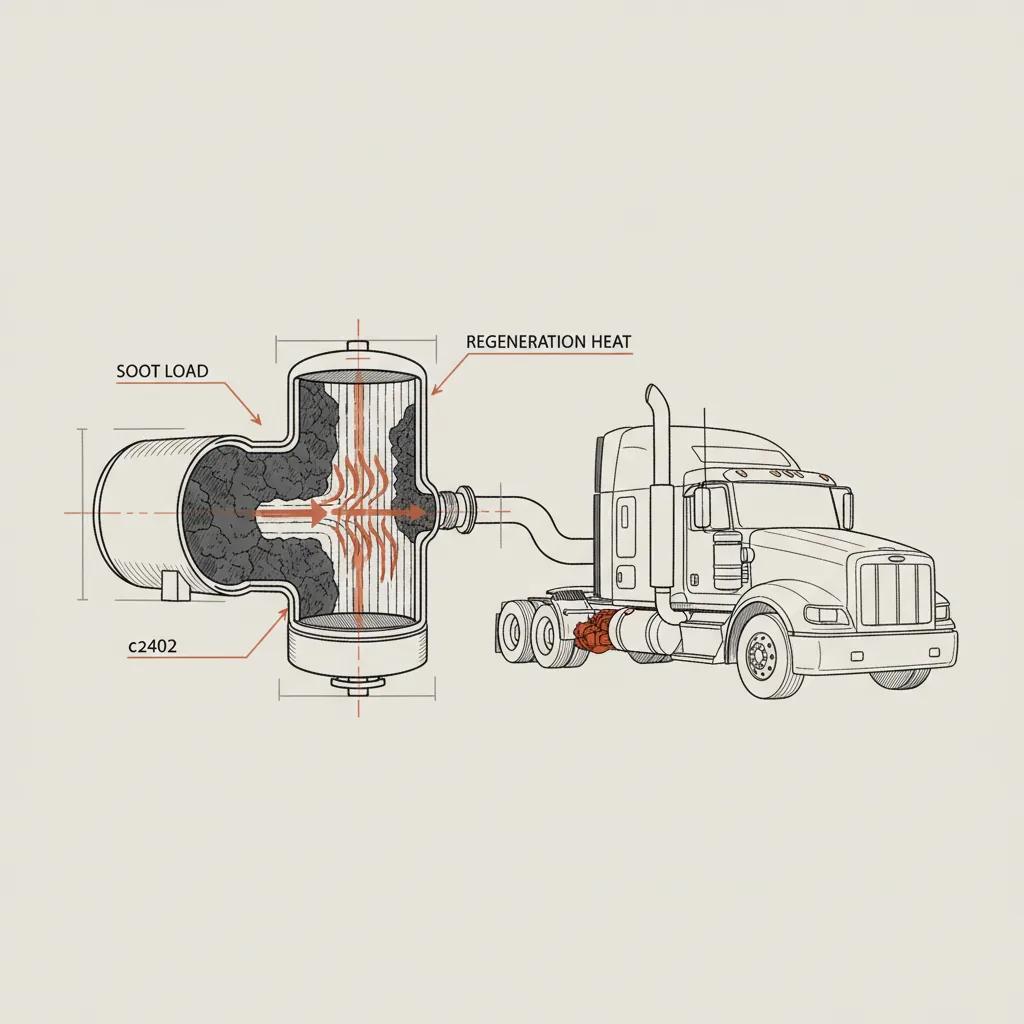
A DPF regeneration most often fails to complete because the engine can't reach or hold the high exhaust temperatures the cycle needs, because a sensor (pressure or temperature) is feeding bad data, because the filter is too loaded with soot or ash to clean, or because an unrelated fault code has disabled regen entirely. Fixing forced regen problems starts with pulling fault codes, confirming the sensors are accurate, and verifying the filter isn't past the point where a regen can recover it.
This matters because a truck stuck in a regen loop loses power, burns extra fuel, and eventually derates or shuts down. Below is a practical breakdown of why regens stall and what actually resolves them.
How a DPF Regen Is Supposed to Work
The diesel particulate filter (DPF) traps soot from the exhaust. To clean itself, the system raises exhaust temperature high enough to burn that trapped soot into ash, which is the regeneration process. There are two main types:
- Passive regen happens automatically during normal highway driving, when exhaust is naturally hot enough to burn off soot. The driver never notices it.
- Active regen is triggered by the engine control module when soot load climbs. The system injects extra fuel to spike exhaust temperature, often signaled by a higher idle, a change in exhaust note, or a dash lamp.
- Forced (parked) regen is a manual cycle a technician or driver starts when the truck can no longer self-clean. It requires the truck to sit, usually with parameters met like coolant temperature, parking brake set, and no disqualifying faults.
A regen "won't complete" when one of these cycles starts but aborts before soot load drops back to normal. Understanding which stage is failing narrows the cause fast.
Common Causes a DPF Regen Won't Complete
The exhaust can't get hot enough
Regen depends on heat. If the system can't reach target temperature, the cycle stalls or aborts. Frequent contributors:
- A failing or contaminated dosing/injection system that can't deliver the fuel needed to raise exhaust temperature.
- Air leaks or a turbo issue lowering exhaust energy.
- Excessive idling and short-haul duty cycles that never let the truck run hot enough for passive regen, so soot keeps building between forced cycles.
- A stuck or failing EGR valve diluting and cooling the exhaust stream.
Sensor faults feeding bad data
The ECM relies on differential pressure sensors (measuring restriction across the filter) and exhaust gas temperature (EGT) sensors to manage and verify a regen. When these read wrong, the controller either won't start a regen or thinks the filter is fine when it isn't.
- A clogged or kinked DPF differential pressure line gives a false restriction reading.
- A failed EGT sensor can prevent the system from confirming target temperature, aborting the cycle.
- Wiring or connector corrosion on these sensors is a common and overlooked culprit.
The filter is too loaded to regen
A regen burns soot, but it cannot remove ash, which accumulates over time. If the filter is overloaded with soot, repeated failed regens, or near the end of its ash service life, a forced regen may abort to protect the system from a runaway temperature event.
- Heavily sooted filters from repeated aborted regens can become "face-plugged" and may need cleaning or replacement rather than another regen attempt.
- Ash buildup at high mileage means the filter eventually needs professional cleaning or replacement; no regen can burn ash out.
A blocking fault code is present
Many systems will refuse to run a regen if certain faults are active, because regen could make a problem worse or run unsafely. Common blockers include active DEF/SCR faults, EGR faults, low coolant temperature, sensor faults in the aftertreatment, or conditions the ECM reads as unsafe for high exhaust temperatures.
Low DEF quality or SCR problems
On trucks with selective catalytic reduction, poor-quality or contaminated diesel exhaust fluid (DEF) and SCR-side faults can trigger codes that interfere with the aftertreatment system and, in turn, block or complicate regen. TheEPAsets the standard for DEF as a 32.5% urea solution; fluid that is diluted, contaminated, or stored improperly can cause downstream faults.
How to Diagnose Forced Regen Problems
Work from data, not guesses. A repeatable approach:
1. Pull all fault codes with a diagnostic scan tool, not just the dash lamps. Note active versus inactive codes across the engine and aftertreatment systems. 2. Check soot and ash load in live data. A very high soot load with a clean ash count points toward a regen or sensor problem; a high ash count points toward filter service life. 3. Verify the differential pressure reading and inspect the pressure lines for kinks, soot, or moisture. 4. Test the EGT sensors against live data during a commanded regen to confirm the exhaust is actually reaching target temperature. 5. Inspect the dosing/injection components and look for leaks, restrictions, or contamination. 6. Confirm DEF quality and SCR status if codes point that direction. 7. Attempt a commanded (forced) regen only after blocking faults are cleared, and watch whether temperatures climb and soot load falls.
This sequence usually isolates whether you're dealing with a sensor, a heat-delivery problem, a loaded filter, or an unrelated fault locking out the cycle.
How to Fix It
The fix depends on the cause, but the common repairs are:
- Replace failed sensors (differential pressure or EGT) and repair corroded wiring or connectors.
- Clear the pressure lines if they're kinked or plugged.
- Repair the heat source by addressing dosing/injection faults, EGR problems, air leaks, or turbo issues so the exhaust can reach regen temperature.
- Clean or replace the DPF when it's face-plugged with soot or at the end of its ash service life. Professional cleaning restores a filter that's ash-loaded but otherwise serviceable; a damaged or melted filter needs replacement.
- Correct DEF/SCR issues, including draining bad DEF and resolving SCR faults, before retrying a regen.
- Adjust duty cycle where possible so the truck gets enough highway running for passive regen between forced cycles.
What you should not do is delete or tamper with the emissions system. It's illegal under federal law, the EPA enforces against tampering, and it doesn't address the underlying mechanical fault.
When to Call for Help Instead of Forcing Another Regen
Repeatedly hammering the forced-regen button on a filter that keeps aborting can make things worse, baking soot harder into the filter or pushing the truck into a derate. Call for service when:
- The truck has derated or is in limp mode.
- A forced regen aborts more than once.
- Soot load won't drop even after a completed cycle.
- You see active aftertreatment, EGR, or SCR fault codes you can't clear.
- The DPF is at high mileage and likely needs cleaning or replacement.
Because DPF and aftertreatment work often happens when a truck is already down, mobile diagnosis and repair keeps you from towing a loaded trailer to a shop. Our team handles DPF and DEF system repair on-site, and pairs it with diesel engine repair when the root cause is upstream of the filter.
FAQ
Why does my forced regen keep stopping before it finishes?
The most common reasons are an exhaust temperature that won't reach target, a faulty pressure or EGT sensor, a filter too loaded with soot or ash to recover, or an active fault code that blocks the cycle. A diagnostic scan and live-data check during a commanded regen will show which one.
Can I keep driving if my DPF won't regen?
You can sometimes drive short term, but soot will keep building, and the truck will likely derate or enter limp mode to protect itself. Driving on a failing regen also risks plugging the filter harder, which can turn a sensor repair into a filter replacement.
Will a forced regen fix a clogged DPF?
A forced regen burns off soot, but it cannot remove ash. If the filter is plugged with ash at high mileage or face-plugged from repeated failed regens, it needs professional cleaning or replacement, not another regen.
Does bad DEF affect DPF regen?
Indirectly, yes. On SCR-equipped trucks, contaminated or out-of-spec DEF can trigger aftertreatment fault codes that block or interfere with regen. The EPA specifies DEF as a 32.5% urea solution; diluted or contaminated fluid causes faults.
How do I know if it's a sensor or the filter itself?
Live data is the tell. A high soot load with normal ash and questionable pressure or temperature readings points to a sensor or heat-delivery issue. A high ash count with the filter near end of service life points to the filter. A technician confirms by testing sensors against actual exhaust conditions during a regen.
Get Forced Regen Problems Sorted On-Site
If your truck is stuck in a regen loop, derated, or throwing aftertreatment codes anywhere in the Sacramento metro or along the I-5, I-80, US-50, and CA-99 corridors, call 916 Truck Repair at (916) 898-9090 for 24/7 mobile dispatch. We diagnose and repair DPF, DEF, and SCR issues where your truck sits so you can get back to your route.
 By Vladimir Sardari · Owner & Lead Technician