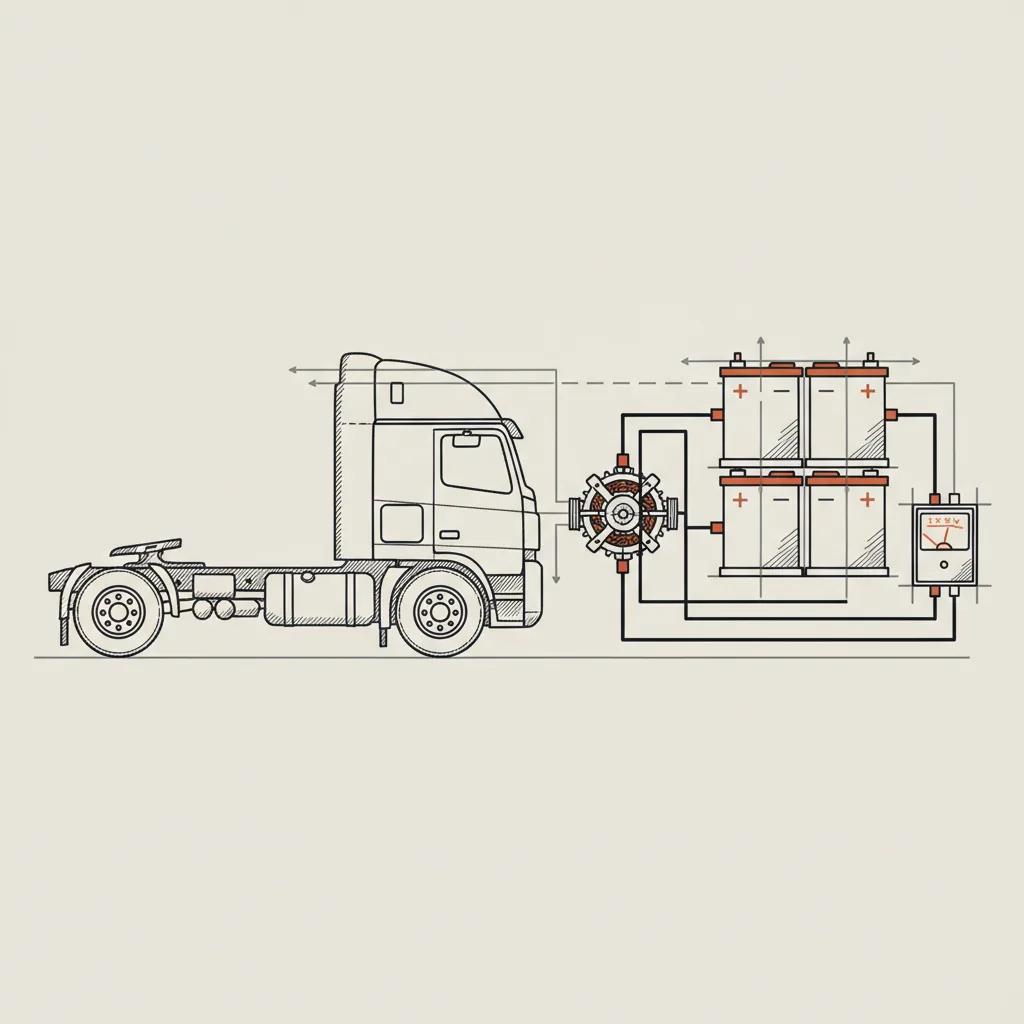
To tell a truck alternator vs battery failure apart, run one quick test: jump-start the engine, then disconnect the jumper. If the engine keeps running, you have a battery problem; if it dies within a minute or two, the alternator isn't charging. A bad battery struggles to crank or hold a charge overnight, while a bad alternator lets a fully charged battery drain while you drive, often with dimming lights and a battery warning lamp.
If the voltmeter reads lower at the batteries than at the alternator output stud, a small gap is normal — that difference is voltage drop in the charging circuit. Delco Remy's limit for a 12-volt system is 0.500 volt of total loss with the positive and negative sides measured together, so check the ground side as well as the feed. Above that, the fault is a cable, a connection, or a ground, not the alternator or the batteries. Test the batteries first: above 12.4 volts no-load before any charging test.
Both failures look identical at the moment your semi won't start, which is why so many drivers and dispatchers misdiagnose them and replace the wrong part. Below is how to read the symptoms, confirm the cause with a voltmeter, and decide what to do roadside.
Why the Two Failures Look the Same
The battery and the alternator are a team. The battery stores the energy needed to crank the engine. Once the engine is running, the alternator takes over: it powers every electrical load and recharges the battery for the next start. When either part fails, the end result is the same dead truck, so the only reliable way to separate them is to test how the system behaves while the engine runs.
A heavy-duty truck also runs multiple batteries wired together (commonly three or four 12-volt batteries in a parallel bank), plus a heavy-gauge cable network and ground connections. A single corroded terminal or a failed cell in one battery can mimic an alternator problem, so a clean visual inspection comes first.
Symptoms That Point to the Battery
Battery faults usually show up at startup, especially after the truck has sat overnight or in cold weather.
- Slow, labored cranking, or a single click and nothing
- The truck starts fine on a jump but won't start again the next morning
- Dash lights and gauges are weak or flicker only while cranking
- Visible corrosion, swelling, or a cracked case on one or more batteries
- Batteries are several years old (most truck batteries have a service life of a few years, and they degrade faster in summer heat)
A classic battery tell: the engine cranks strong once you jump it, runs normally, and keeps running after you remove the jumper cables. That means the charging system is doing its job and the battery simply couldn't hold enough charge to crank on its own.
Symptoms That Point to the Alternator
Alternator faults tend to appear while you're driving, because that's when the charging load matters most.
- The battery or charge warning light comes on while underway
- Headlights and dash lights dim, brighten with engine RPM, or flicker
- A whining or grinding noise from the front of the engine near the belt
- A burning-rubber or hot-electrical smell from a slipping or glazed belt
- The truck dies shortly after a jump-start once the cables are removed
- Repeated dead batteries even after the batteries themselves test good
If you replace a battery and the new one goes dead within days, the alternator is the prime suspect. It charged the old battery to death, and it will do the same to the new one until the charging fault is fixed.
How to Confirm It With a Voltmeter
A digital multimeter across the battery terminals settles most arguments in under five minutes.
Engine off (resting voltage)
- Roughly 12.6 volts indicates a healthy, fully charged 12-volt battery
- Around 12.2 volts or lower suggests a discharged or weak battery
- A reading near 10.5 volts or below often points to a dead or shorted cell
Engine running (charging voltage)
- Roughly 13.7 to 14.5 volts means the alternator is charging correctly
- A reading that stays near 12 volts or below with the engine running means the alternator is not charging
- A reading above about 15 volts can indicate an overcharging alternator or a failed voltage regulator, which boils batteries and shortens their life
For a quick check without tools, the jump-and-disconnect test described in the intro works well: if the engine quits soon after you pull the cables, the alternator is the culprit.
Don't Overlook These In-Between Causes
Not every no-start traces back to a single failed component. Before condemning a battery or alternator, rule out:
- Loose or corroded terminals and grounds. High resistance at a connection starves the starter and confuses voltage readings.
- A slipping, glazed, or loose serpentine belt. The alternator can be perfectly good but spinning too slowly to charge.
- A blown fusible link or failed charge cable. The alternator produces power, but it never reaches the battery bank.
- A failed voltage regulator. On many heavy-duty alternators this is integral, so a regulator fault means the whole unit is replaced.
- Parasitic draw. A stuck relay, an aftermarket accessory, or a wiring fault can drain a good battery overnight and imitate a charging problem.
These wiring and connection issues are common on high-mileage trucks and are easy to miss with a parts-swap approach. If the basics test fine but the problem persists, the fault often lives in the harness. Our electrical and wiring repair techs trace charging-circuit faults rather than guessing at parts.
What to Do Roadside
If you're stranded along I-5, I-80, CA-99, or US-50, a few steps protect you and your equipment:
- Get the truck to a safe shoulder or lot and set out warning triangles.
- If lights are dimming and the charge light is on, shut down nonessential electrical loads to stretch your remaining battery charge.
- A jump-start may get you running, but if the alternator isn't charging, you have only a short window before the truck dies again, so don't rely on it for a long haul.
- Have the battery bank and charging output tested before you replace anything, so you fix the actual fault the first time.
For a confirmed battery or charging failure, a mobile technician can test the system and handle a battery replacement or alternator repair on-site, so you avoid a tow and get rolling again.
FAQ
Can a bad alternator drain a battery overnight?
Indirectly, yes. A failing alternator that doesn't charge will leave the battery undercharged after every drive until it can no longer crank the engine. Some alternator faults, such as a shorted diode, can also create a small parasitic draw that pulls the battery down while the truck is parked.
Will my semi run on the battery alone if the alternator fails?
Only briefly. The engine will keep running on stored battery power, but once that charge is depleted, often within minutes to an hour depending on electrical load, the truck will stall. Replacing the battery without fixing the alternator just resets that short countdown.
How long do truck batteries last?
Most heavy-duty truck batteries last a few years, but heat, vibration, deep discharges, and a faulty charging system shorten that life considerably. Sacramento Valley summer temperatures are especially hard on batteries, so testing them ahead of the hot season is worthwhile.
Is it the starter instead of the battery or alternator?
It can be. If the battery tests fully charged and the connections are clean but the engine still won't crank, often just a single click, the starter motor or solenoid is a likely cause. A load test on the battery and a check of starter current help separate the two.
Should I replace the battery and alternator at the same time?
Not automatically. Replace only the part that fails the test. However, if an overcharging alternator damaged the batteries, or the batteries are already near the end of their service life, replacing both at once can prevent a repeat breakdown. Let the voltage readings decide.
Get It Diagnosed Right the First Time
Guessing between a battery and an alternator usually means buying the wrong part and breaking down again. 916 Truck Repair provides mobile, on-site diagnosis and charging-system repair across Sacramento and Northern California, including the I-5, I-80, CA-99, and US-50 corridors and cities like Elk Grove, Stockton, Roseville, and Woodland. Call (916) 898-9090 for 24/7 mobile dispatch and get your semi tested, fixed, and back on the road.
 By Vladimir Sardari · Owner & Lead Technician