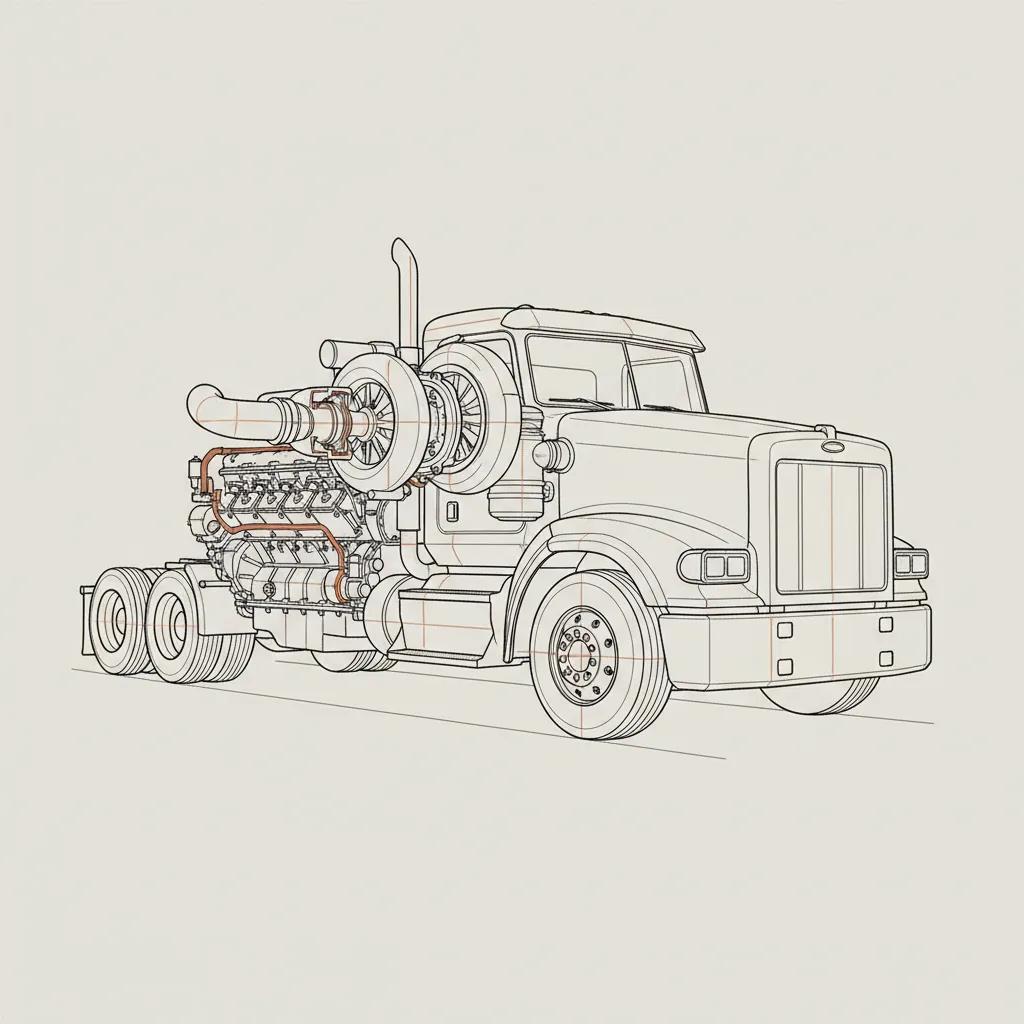
The most common turbo failure signs on a semi truck are a noticeable loss of power and acceleration, blue or black exhaust smoke, a high-pitched whining or whistling from the turbo, and rising oil consumption. A boost-related fault code or a glowing check-engine light often accompanies these symptoms. Catching them early usually means a turbo replacement instead of a turbo plus a wiped-out diesel engine.
A turbocharger forces extra air into the cylinders so your engine can burn more fuel and make the power needed to pull a loaded trailer up a grade. It spins on a thin film of oil at very high speed and runs extremely hot, which is exactly why it fails in ways that show up as drivability and exhaust problems long before the unit seizes. Knowing what those symptoms mean helps you decide whether to keep rolling, shut down, or call for a mobile truck repair tech on the shoulder.
The Most Common Turbo Failure Signs
Turbo problems rarely announce themselves with one dramatic event. They build over days or weeks, and the symptoms overlap with other issues, so it pays to read them together rather than in isolation.
Loss of power and slow acceleration
The clearest turbo failure sign is power that has quietly disappeared. The truck feels gutless on hills, takes longer to get up to highway speed, and the engine works harder to do the same job it did last month. When a turbo can't build proper boost — because of a worn bearing, a cracked housing, a stuck variable-geometry mechanism, or a leak in the charge-air piping — the engine simply isn't getting enough air.
Many modern diesels will also pull the engine into a reduced-power or derate state when boost pressure falls outside the expected range, which protects the engine but leaves you crawling.
Blue, black, or excessive exhaust smoke
Exhaust smoke is one of the most telling symptoms because the color points toward the cause:
- Blue or gray smoke usually means the turbo is passing engine oil into the intake or exhaust, typically from failed seals or worn shaft bearings. The engine is burning oil it shouldn't be.
- Black smoke points to an air-to-fuel imbalance — the engine is getting fuel but not enough air, which happens when the turbo isn't compressing properly or a boost leak is bleeding off pressure.
- Heavy smoke under acceleration that wasn't there before is worth investigating even if it clears at cruise.
Whining, whistling, or grinding noise
A healthy turbo makes a smooth, faint whoosh. A failing one often produces a loud, high-pitched whine or siren-like whistle that rises with engine speed. That noise frequently signals a boost leak or worn bearings letting the shaft move out of true. A rough grinding or rattling sound is more serious — it can mean the compressor or turbine wheel is contacting the housing, and continued driving risks throwing debris into the engine.
Rising oil consumption
If you're adding oil more often and don't see drips on the ground, the turbo is a prime suspect. Failed turbo seals let oil migrate into the intake or exhaust stream, so it gets burned instead of leaking out where you'd notice it. Track your oil top-offs — a steady climb without an external leak is a meaningful clue.
Check-engine light and boost-related fault codes
The engine's ECM monitors boost pressure, intake air, and turbo actuator position. When readings drift outside spec, it sets a code and often illuminates the check-engine or warning lamp. Codes pointing to low boost, boost pressure deviation, or turbo actuator/VGT faults are direct indicators. Pulling codes with a scan tool turns a vague "it feels weak" complaint into a specific diagnosis. Our guide to reading diesel fault codes walks through how to interpret what the ECM is telling you.
What Causes Turbochargers to Fail
Understanding the root cause helps you prevent a repeat failure. According to engine manufacturers such as Cummins, the large majority of turbocharger failures trace back to problems with oil supply, contamination, or foreign-object damage rather than a defect in the turbo itself.
Oil supply and oil quality problems
The turbo bearing system depends entirely on clean, pressurized oil. Anything that interrupts that supply or contaminates it shortens turbo life dramatically:
- Missed oil changes or extended drain intervals that let oil break down
- A clogged or restricted oil feed line
- Low oil level or low oil pressure
- Coking — oil baking onto hot turbo parts when a hot engine is shut down immediately after hard work
Foreign object damage and contamination
The compressor and turbine wheels spin fast enough that even small debris does real harm. A torn or missing air filter element lets dust and grit into the compressor; broken pieces from upstream engine components can strike the turbine side. Either one chips the wheel, throws it out of balance, and accelerates bearing wear.
Boost leaks and cracked components
Charge-air coolers, intercooler piping, and clamps live in a high-pressure, high-vibration, temperature-cycling environment. Cracked piping or a loose clamp bleeds off boost, which mimics turbo failure and forces the engine to overwork. On variable-geometry turbos, the actuator and vanes can stick from soot buildup, throwing boost control off entirely.
What to Do When You Notice the Signs
A turbo that's beginning to fail can quickly become a turbo that destroys an engine if you ignore it. How you respond depends on the symptom.
Keep driving, slow down, or shut down?
- Loud grinding, sudden heavy smoke, or a turbo that just got very loud: Reduce power and get off the road safely. Continued driving risks sending metal into the cylinders.
- Gradual power loss with a check-engine light: You can usually limp to a safe stop, but get it diagnosed before the next loaded run.
- Low oil pressure warning with any turbo symptom: Shut down. Running a turbo without oil pressure can ruin it in minutes and damage the engine behind it.
Get an accurate diagnosis
Because boost leaks, air-filter restriction, sensor faults, and a genuinely failed turbo all produce similar symptoms, the smart move is a proper diagnosis before replacing parts. A technician can read fault codes, check actual boost pressure, inspect the charge-air system for leaks, and feel the turbo shaft for play. That prevents the costly mistake of bolting on a new turbo when a cracked intercooler hose was the real problem. A mobile tech can perform this on-site, which matters when the truck is loaded and parked at a yard or rest area. Learn more about our approach to diesel engine repair and turbo diagnostics.
What drives the cost of the repair
We don't quote a flat price because several factors move the number:
- Whether the unit can be replaced or whether the engine also took damage
- The truck's make, engine, and turbo type (fixed vs. variable-geometry)
- Whether collateral parts — air filter, oil, charge-air piping, gaskets — need replacing too
- Whether the repair is done on-site or requires a tow to a facility
Finding and fixing the root cause — a clogged oil line, a torn air filter, a missed service interval — is what keeps the replacement turbo from failing the same way.
FAQ
Can I keep driving a semi with a failing turbo?
It depends on the symptom. Mild power loss may let you reach a safe stop, but grinding noise, heavy smoke, or a low-oil-pressure warning means you should reduce power and shut down. Driving on a failing turbo can throw debris into the engine and turn a turbo repair into an engine repair.
What does blue smoke from the exhaust mean on a diesel?
Blue or gray smoke usually means engine oil is being burned, and a failing turbo passing oil through its seals is a common cause. It can also come from engine wear, so the turbo, seals, and crankcase ventilation should all be checked.
How long does a turbocharger last on a semi truck?
There's no fixed lifespan — it varies widely with maintenance, oil quality, driving conditions, and engine type. Turbos that get clean oil, regular service, and a proper cool-down before shutdown last far longer than ones that don't.
Why did my new turbo fail again?
A replacement turbo that fails quickly almost always points to an unaddressed root cause: a restricted oil feed line, contaminated oil, a torn air filter, or a boost leak. The underlying problem has to be fixed when the turbo is replaced.
Is a whining noise always a turbo problem?
Not always. A rising whine or whistle often signals a boost leak or worn turbo bearings, but loose clamps and cracked charge-air piping can make similar sounds. A boost-pressure test and visual inspection confirm whether the turbo itself is the source.
Don't Let a Turbo Take Out Your Engine
If your truck is down on power, smoking, or whining and you're anywhere in the Sacramento metro or along the I-5, I-80, CA-99, or US-50 corridors, call 916 Truck Repair at (916) 898-9090 for 24/7 mobile dispatch. We come to you — yard, rest area, or roadside — to diagnose the real cause before it costs you an engine.
 By Vladimir Sardari · Owner & Lead Technician