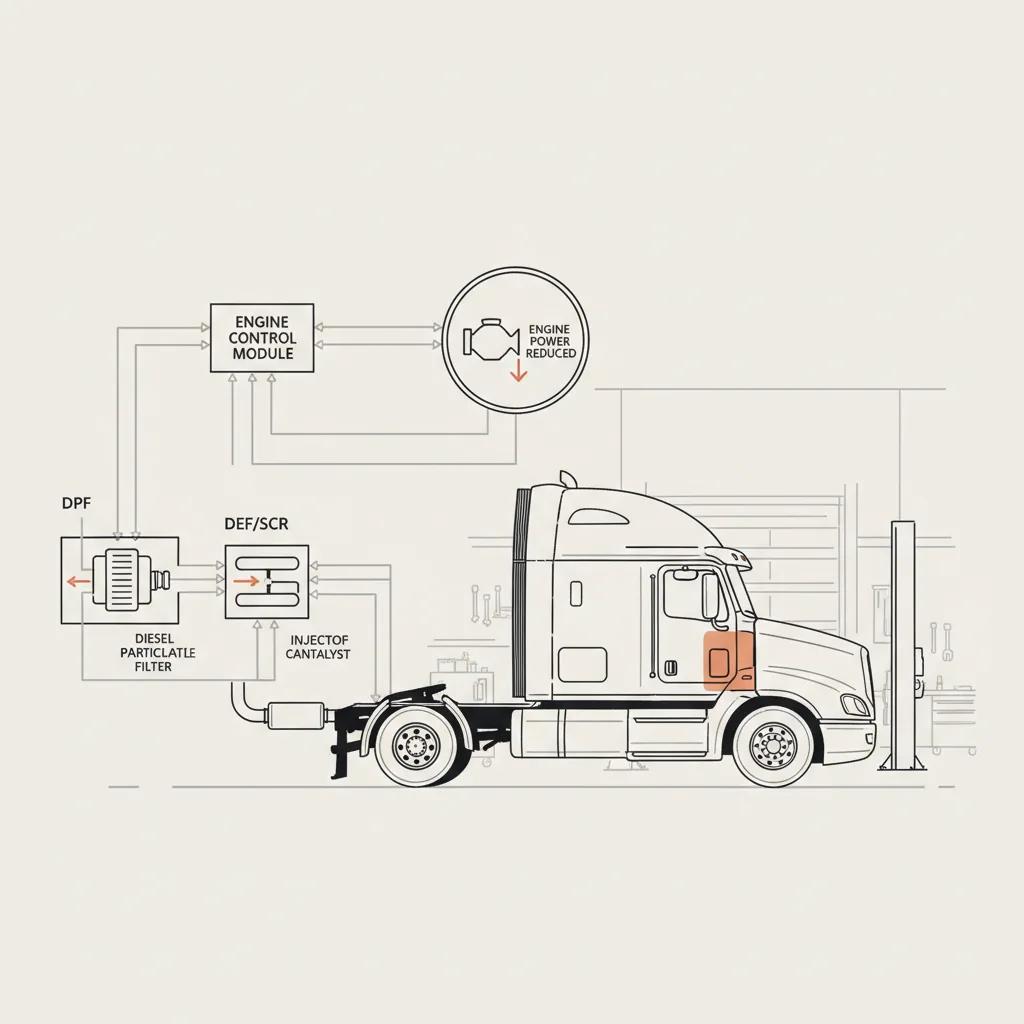
An engine derate is when a diesel truck's engine control module (ECM) deliberately reduces engine power, torque, or road speed to protect the engine or to force a driver to address an unresolved fault. It is not a mechanical failure in itself; it is the truck's onboard computer reacting to a sensor reading or an emissions condition it has flagged as out of range. Most modern derates are tied to the aftertreatment (DPF/DEF/SCR) system, but they can also come from low oil pressure, high coolant temperature, or boost and turbo faults.
If your truck has started losing power, capping its speed, or refusing to rev past a certain RPM, the ECM is almost certainly enforcing a derate. Below are the causes, how derate differs from limp mode, the warning stages, and what to do when it happens.
What an Engine Derate Actually Is
Diesel engines today are governed by an ECM that constantly watches dozens of sensors. When it sees a reading that signals a risk to the engine or a violation of emissions requirements, it intervenes by reducing fueling, limiting torque, or capping vehicle speed. That intervention is the engine derate.
Derates fall into two broad buckets:
- Protective derates — triggered by conditions that could physically damage the engine, such as low oil pressure, high coolant or oil temperature, or low coolant level. The ECM pulls power to keep the engine from destroying itself.
- Emissions derates — triggered by the aftertreatment system. A clogged diesel particulate filter (DPF), an empty or contaminated diesel exhaust fluid (DEF) tank, a failed DEF quality sensor, or a selective catalytic reduction (SCR) fault will all start a countdown that ends in reduced power and, eventually, a crawl-speed limit.
The key point: a derate is a symptom and a warning, not the root problem.
Engine Derate vs. Limp Mode: The Difference
Drivers use "derate" and "limp mode" interchangeably, but they describe different severities of the same protective behavior.
- Engine derate is the broader term. It can be mild — a modest reduction in horsepower or a speed cap — that still lets you drive to a safe location or a shop.
- Limp mode (sometimes "limp-home mode") is the most aggressive stage of derate. The engine is restricted to very low RPM and a crawl speed, often just a few miles per hour, so the truck is barely mobile and is essentially demanding immediate service.
Think of it as a staircase: the system rarely drops you straight into limp mode. It steps you down through warning lamps and partial power reductions first, and limp mode is the bottom step.
Common Causes of Engine Derate
Aftertreatment and Emissions Faults
The most frequent cause of derates on late-model trucks is the emissions system:
- DPF clogged or regen not completing — when the particulate filter loads with soot and a regeneration can't finish, the ECM derates to prevent further loading.
- Low or poor-quality DEF — running the DEF tank low, or filling with contaminated or non-spec fluid, triggers a staged derate. The U.S.EPA's emissions regulations require these inducements so that trucks can't be operated indefinitely with a defeated emissions system.
- DEF quality or NOx sensor faults — bad readings from these sensors can start a derate even when the fluid itself is fine.
- SCR system faults — wiring, dosing, or catalyst problems in the SCR circuit.
Engine-Protection Faults
- Low oil pressure — one of the fastest paths to an aggressive derate, because the engine can be ruined in minutes without oil pressure.
- High coolant temperature — an overheating engine will be derated to shed load.
- Low coolant level — many ECMs derate on a low-coolant signal even before temperature spikes.
- Turbo and boost faults — a failing variable-geometry turbo, a boost-pressure sensor out of range, or a charge-air leak.
- Fuel system issues — water in fuel, low rail pressure, or injector faults.
Sensor and Wiring Problems
A surprising share of derates trace back to a single failed sensor, a corroded connector, or chafed wiring rather than a genuine mechanical failure. A NOx sensor, exhaust temperature sensor, or oil pressure sensor reporting a false value will make the ECM act as if the condition is real.
The Warning Stages Before a Full Derate
Most diesel platforms walk through a predictable sequence so the driver has time to react:
- Stage 1 — Dash warning. A check-engine light, an emissions warning lamp, or a DEF-level lamp comes on. Power is usually still normal. This is your cheapest moment to act.
- Stage 2 — Partial derate. Horsepower and torque are reduced, sometimes with a flashing lamp or audible alert. The truck still drives but feels sluggish, especially under load or on grades.
- Stage 3 — Speed limit / limp mode. Road speed is capped to a crawl. At this stage you have limited ability to reposition the truck, and a service call is effectively mandatory.
Ignoring Stage 1 is how most drivers end up stranded at Stage 3 on the shoulder of I-5 or I-80. The earlier you address the trigger, the more options you keep.
What to Do When Your Truck Derates
- Get to a safe location. If power is dropping, plan to exit or pull over before you lose more speed. Don't wait to see how far it goes.
- Note the dash lamps and any messages. Which lights are on — check engine, DEF, coolant, oil — narrows the cause quickly for whoever services the truck.
- Check the obvious. Confirm DEF level, look for coolant or oil warnings, and check for visible leaks or steam. A low DEF tank you can top off may be the entire fix.
- Have the codes read. A technician with a diagnostic scan tool can pull the active and stored fault codes, which point directly at the system that triggered the derate.
- Don't keep pushing a protective derate. If the derate is tied to low oil pressure or high coolant temperature, continuing to drive risks catastrophic, expensive engine damage. A mild emissions derate may let you reach a shop; a protection derate often should not be driven on.
Do not attempt to disable or tamper with the emissions system to clear an inducement. Beyond being illegal under EPA rules, it masks a real condition that will keep escalating.
For faults that strand you, roadside truck repair brings a technician and scan tool to the truck so the codes can be read and many causes resolved on the spot. When the derate is rooted in the emissions system, DPF and DEF system repair addresses the clogged filter, failed sensor, or dosing fault behind it.
How Derates Are Diagnosed and Repaired
Proper diagnosis starts with reading fault codes, then verifying whether the flagged condition is genuine or a sensor reporting a false value. From there the repair depends on the trigger:
- A clogged DPF may need a forced regeneration or a filter cleaning/replacement.
- A DEF-related derate may come down to fluid quality, a dosing unit, or a quality sensor.
- A protective derate points to the mechanical system named by the code — oil pressure circuit, cooling system, turbo, or fuel system.
- A wiring or connector fault gets traced and repaired so the ECM stops seeing the false signal.
Because derates touch the engine, emissions, and electrical systems at once, accurate diagnosis beats guessing at parts. Related work often overlaps with diesel engine repair when the trigger is mechanical rather than emissions-related.
FAQ
Can I keep driving with an engine derate?
It depends on the type. A mild emissions derate may let you reach a shop, but a protective derate caused by low oil pressure or high coolant temperature can lead to severe engine damage if you keep driving. When in doubt, stop and have the codes read.
What's the difference between a derate and limp mode?
Derate is the general term for the ECM reducing power to protect the engine or force a repair. Limp mode is the most severe stage of derate, where the truck is restricted to a crawl speed and is barely drivable.
Why did my truck derate after the DEF light came on?
Under U.S. EPA emissions rules, low or poor-quality DEF triggers a staged inducement that reduces power over time. Topping off with proper-spec DEF may resolve it, but if a quality or NOx sensor has failed, the derate will persist until that fault is repaired.
Will a derate clear itself?
Sometimes. If the trigger was a temporary condition that resolves — like a completed regeneration or a refilled DEF tank — the ECM may restore power. A derate tied to a hard fault or failed component will not clear until the underlying problem is fixed.
Does an engine derate mean my engine is damaged?
Not necessarily. The derate is a protective response designed to prevent damage. In many cases the engine is fine and the trigger is a sensor, the DEF system, or a clogged filter. Ignoring repeated derates, however, can lead to real damage.
Get Help When Your Truck Derates
If your diesel is losing power or capping its speed on I-5, I-80, CA-99, US-50, or anywhere across the Sacramento metro and Northern California, don't keep pushing it. Call 916 Truck Repair at (916) 898-9090 for 24/7 mobile dispatch. A technician can come to your truck, read the codes, and get you back on the road safely.
 By Vladimir Sardari · Owner & Lead Technician