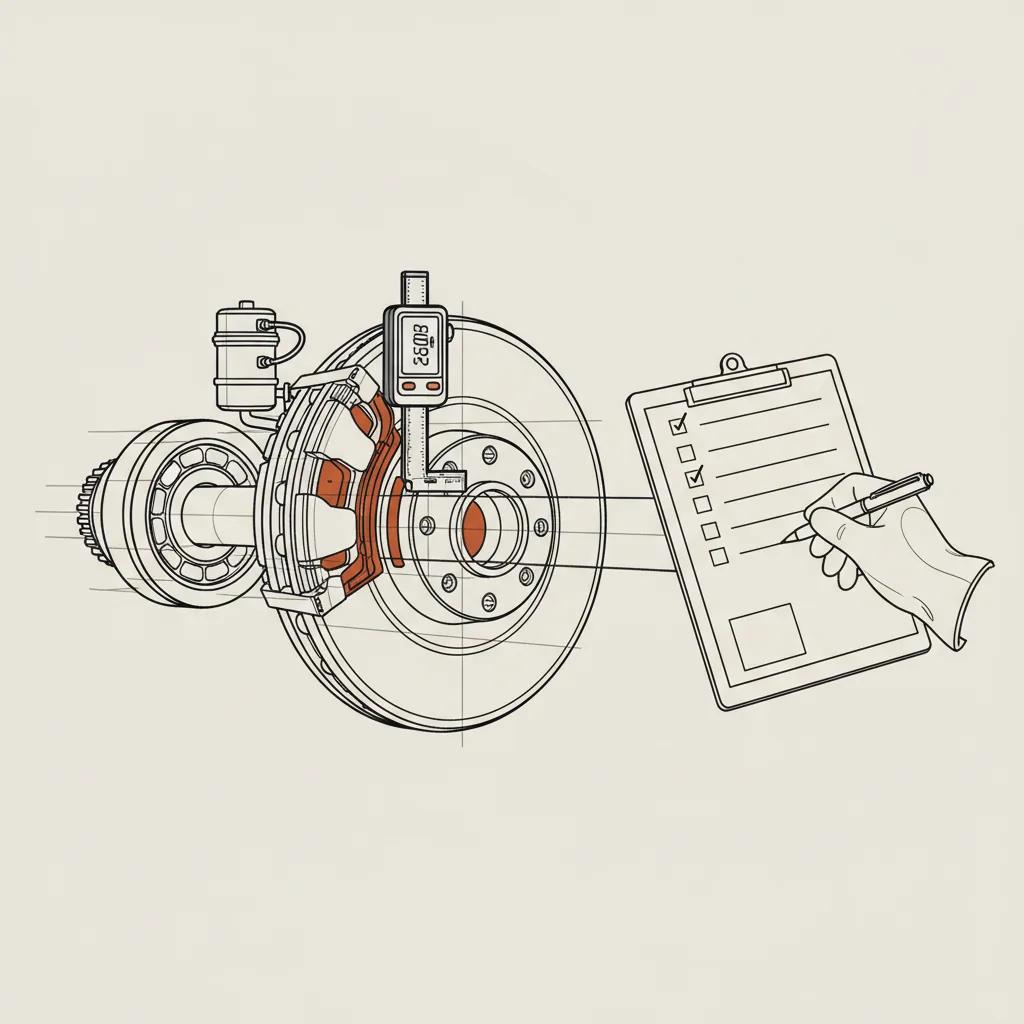
A DOT brake inspection checks every component of a commercial vehicle's braking system against federal out-of-service standards, including pushrod stroke (adjustment), lining and pad thickness, air-loss rate, the low-air warning device, drums, rotors, hoses, slack adjusters, and ABS function. A truck or trailer is placed out of service when 20% or more of its brakes are defective, or when any single critical defect is found. The fastest way to pass is to inspect those same items yourself before an officer ever does.
Brakes are the single most cited equipment category in roadside enforcement. During the annualCVSAInternational Roadcheck, brake-related problems routinely account for the largest share of out-of-service vehicle violations, which makes a working knowledge of the checklist below one of the highest-return things an owner-operator or fleet can master.
What a DOT Brake Inspection Actually Covers
A DOT brake inspection follows the same criteria a roadside officer uses: the Commercial Vehicle Safety Alliance (CVSA) out-of-service standards built on the Federal Motor Carrier Safety Regulations (49 CFR Part 393 andPart 396). Whether it is a Level I roadside inspection, a fixed weigh-station check, or your own pre-trip, the components and limits are the same. The inspection looks at both the mechanical condition of each brake and how the system performs as a whole.
The core components checked
- Pushrod stroke (brake adjustment) — the travel of the slack adjuster and pushrod when the brakes are applied. Stroke past the adjustment limit for that chamber size is one of the most common findings.
- Lining and pad thickness — drum-brake linings and disc pads must meet minimum thickness and show no cracks, contamination, or missing sections.
- Drums and rotors — checked for cracks, deep scoring, and being worn beyond the manufacturer's discard dimension.
- Air-loss rate — with the engine off and brakes applied, the system must not leak faster than the allowable rate.
- Low-air warning device — the buzzer or light must activate before pressure drops to 55 psi.
- Air hoses, tubing, and chambers — inspected for cracks, chafing, bulges, audible leaks, and secure mounting.
- Slack adjusters — must be properly adjusted, secure, and matched left-to-right on an axle.
- ABS function — the malfunction lamp must work and not stay illuminated; trailers built with ABS must have a functioning external lamp.
- Brake hardware and mounting — cracked or loose chambers, broken springs, and missing components are all defects.
Your Pre-Inspection Brake Checklist
Run this before any DOT inspection, before a long haul, or as part of your daily pre-trip. It mirrors what an officer will check, so anything you catch here is a violation you avoid on the road.
Air system and warnings
- Build air pressure to governor cut-out (around 120–130 psi), then shut the engine off.
- With brakes released, watch for static air loss — it should be minimal over one minute.
- Apply and hold the brakes and watch the gauge; applied air loss should stay within limits with no audible hiss at the chambers or gladhands.
- Fan the brakes down and confirm the low-air warning activates by 55 psi and that the spring (parking) brakes set automatically as pressure continues to drop.
- Drain the air tanks and check for excessive water or oil, which signals a failing dryer.
Mechanical condition at each wheel
- Check pushrod stroke on every chamber against the adjustment limit; uneven or long stroke means a brake that is not contributing.
- Measure or eyeball lining and pad thickness; replace before it reaches minimum, not after.
- Look for grease or oil on linings, which can come from a leaking wheel seal and ruins braking.
- Inspect drums and rotors for cracks and heat checking.
- Confirm slack adjusters are secure, the same length side to side, and move freely.
Hoses, lines, and ABS
- Trace every air hose for chafing against the frame, kinks, and bulges under pressure.
- Inspect gladhand seals and couplers on the trailer for leaks.
- Cycle the key and confirm the tractor and trailer ABS lamps illuminate during the bulb check and then go out.
- Verify the trailer's external ABS malfunction lamp works.
If you find a brake out of adjustment, a chafed hose, or an ABS fault you cannot clear, it is cheaper to fix it in the yard than to be sidelined at an inspection station. A mobile air brake repair call gets the rig back to spec without dragging it to a shop.
What Puts a Truck or Trailer Out of Service
The out-of-service decision is based on defined defects, not an officer's mood. The headline rule is the 20% defective brakes standard: if 20% or more of the service brakes on the vehicle have a defect that makes them ineffective, the unit is placed out of service. A combination vehicle is evaluated across all its brakes, so weak trailer brakes can sideline a perfectly good tractor.
Individual out-of-service conditions include:
- A brake out of adjustment beyond the stroke limit for that chamber.
- Linings or pads worn below minimum, cracked, or saturated with grease or oil.
- Audible air leaks at a chamber, hose, or gladhand under application.
- A low-air warning device that does not work.
- Cracked drums or rotors beyond allowable limits.
- Missing, broken, or inoperative brake components.
- Air-loss rate exceeding the allowable maximum.
A failed inspection does more than cost a day. Brake violations carry heavy CSA severity weights, and those points follow the carrier's safety record. Keeping a clean brake profile is one of the best ways to stay out of expanded enforcement and intervention. A documented brake check is also exactly what a DOT brake inspection service provides, with the work logged so you have proof the system met standard.
How to Stay Ready Between Inspections
Passing once is easy; staying ready is the real goal. Brakes wear continuously, so the system drifts out of spec on its own schedule, not yours.
- Make pushrod stroke and lining thickness part of every pre-trip rather than a once-a-year scramble.
- Service the air dryer on schedule so moisture does not corrode valves and chambers.
- Address pulling, grabbing, or a soft pedal the day you notice it.
- Keep tractor and trailer brakes balanced; mismatched timing wears one axle faster and shows up as uneven stroke.
- Build brake checks into your preventive-maintenance intervals so adjustments happen before they become violations.
For drivers running the I-5, I-80, CA-99, and US-50 corridors around Sacramento, Elk Grove, Stockton, Roseville, and Auburn, a brake problem found at a scale rarely happens at a convenient time. Catching it on your own checklist is always the cheaper outcome.
FAQ
What is the 20% rule for DOT brake inspections?
If 20% or more of a commercial vehicle's service brakes are defective — out of adjustment, worn out, contaminated, or otherwise ineffective — the vehicle is placed out of service. On a combination unit, all brakes across the tractor and trailer count toward that threshold.
How often do commercial trucks need a brake inspection?
Brakes must be checked at every daily pre-trip and during the required annual DOT inspection, and they can be inspected at any roadside or weigh-station stop. Many fleets also check brakes at each preventive-maintenance interval because linings and adjustment change with use.
What is the most common brake violation?
Brakes out of adjustment — pushrod stroke past the limit for the chamber size — and worn or contaminated linings are among the most frequently cited brake defects in roadside inspections.
Can I drive a truck with the ABS light on?
The ABS warning lamp is allowed to illuminate briefly during the start-up bulb check, but a lamp that stays on indicates a fault that needs diagnosis. A persistent trailer ABS malfunction lamp is a documented defect and should be repaired promptly.
Does a brake defect on the trailer affect the tractor?
Yes. The out-of-service brake calculation counts every brake on the combination. Defective trailer brakes can push the whole unit past the 20% threshold and sideline an otherwise roadworthy tractor.
Need Brakes Checked or Fixed Now?
916 Truck Repair provides mobile, on-site brake service and DOT inspections across the Sacramento metro and Northern California. Call 24/7 dispatch at (916) 898-9090 and get back to standard without leaving the yard or the shoulder.
 By Vladimir Sardari · Owner & Lead Technician