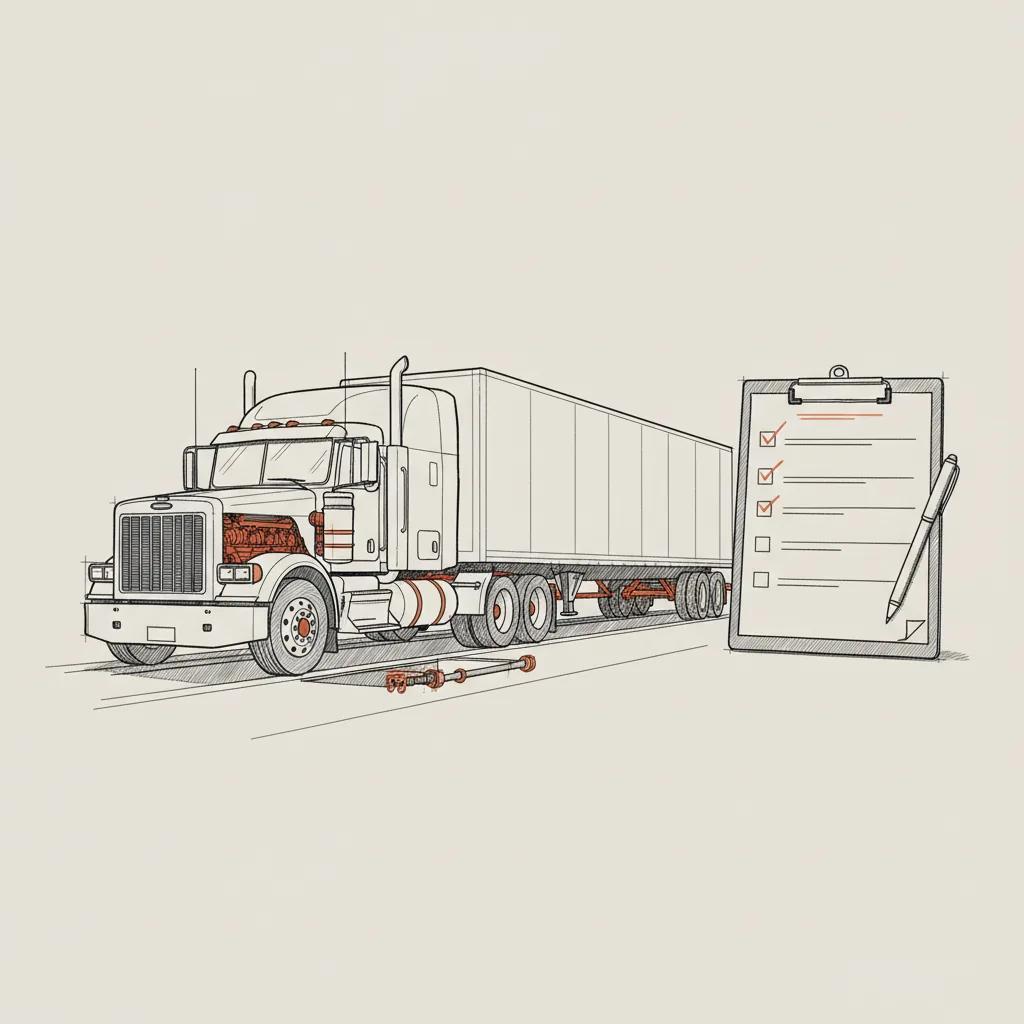
The DOT annual inspection is the once-a-year safety check theFMCSArequires for every commercial motor vehicle and trailer operated in interstate commerce. Under federal rule 49 CFR 396.17, a qualified inspector reviews the entire vehicle against the minimum standards in Appendix A toPart 396, and the unit must pass at least once every 12 months to stay legal on the road. To prep, you walk the truck and trailer through those same component groups ahead of time, fix anything that meets an out-of-service condition, and keep the documentation organized so the inspection itself is fast and clean.
Unlike a roadside brake check, this is a head-to-toe inspection. Brakes are a big part of it, but so are steering, lighting, tires and wheels, the frame, the coupling system, and the exhaust. The fastest way to fail is to focus only on the brakes and let a cracked frame member or a dead marker light surprise you. This guide walks the full FMCSA periodic inspection component by component so you know what the inspector is looking at and how to get ahead of it.
What the DOT annual inspection actually covers
The scope is set by the federal standard, not by the shop. Per FMCSA's Appendix A to 49 CFR Part 396, the periodic inspection covers these systems:
- Brake systems, including air brakes, parking brakes, and brake performance
- Coupling devices: fifth wheels, pintle hooks, and safety devices
- Exhaust system
- Fuel system
- Lighting devices, including all required lamps and reflectors
- Safe loading and securement components
- Steering mechanism
- Suspension
- Frame
- Tires
- Wheels and rims
- Windshield glazing and wipers
A single defect that meets an out-of-service condition fails the vehicle. The goal of prep is to find those conditions yourself first.
Who can perform the inspection
FMCSA requires the inspector to be qualified under 49 CFR 396.19. That means documented training or experience in the brake and component standards. Many fleets use their own qualified staff; owner-operators and smaller fleets typically take the unit to a qualified shop or use a mobile service. Whoever signs the form is certifying the vehicle against the federal minimum standards, so the qualification record matters as much as the inspection itself.
How to prep, component by component
Brakes
Brakes draw the most violations in roadside enforcement, so they deserve a thorough pre-check. Before the inspection:
- Measure lining and pad thickness and replace anything near the limit
- Check pushrod stroke at each wheel and adjust slack adjusters that are near or past the readjustment limit
- Inspect drums and rotors for cracks, heat checking, and scoring
- Run an air-loss test and listen for leaks at chambers, valves, and fittings
- Confirm the low-air warning and parking brake hold both work
For a deeper component-level walkthrough, our DOT brake inspection page breaks the brake portion down in detail. Brake defects are also the top reason a unit is placed out of service at the roadside, so clean brakes pay off all year.
Steering mechanism
The inspector checks steering wheel free play, the column, gear box mounting, pitman arm, tie rods, and ball joints. Prep by jacking the front end, checking for excessive lash or movement at each joint, looking for leaking power steering components, and confirming nothing is loose or cracked.
Suspension and frame
The suspension and frame are easy to overlook and expensive to fail on. Look for:
- Cracked, broken, or shifted leaf springs and broken spring hangers
- Loose or missing U-bolts and axle positioning hardware
- Leaking or damaged air bags and shock absorbers
- Cracks in frame rails, especially near the suspension and fifth wheel mounts
- Loose body or frame fasteners
A cracked frame member or a sagging suspension is a fail, and these problems get worse fast under load on rough corridors.
Tires, wheels, and rims
Tires fail on tread depth, damage, and pressure. The federal minimum tread depth is 4/32 inch on steer tires and 2/32 inch on all other tires. During prep:
- Measure tread at multiple points across each tire
- Look for sidewall cuts, bulges, exposed cord or belt material, and flat spots
- Check for cracked or bent rims, missing or loose lug nuts, and elongated stud holes
- Set every tire to the correct cold pressure for its load
No steer tire may be regrooved or a recap, and no tire may have visible fabric or be flat. Fix these before the truck is on the lift.
Lighting and reflectors
Every required lamp and reflector must be present and working: headlamps, tail lamps, stop lamps, turn signals, marker and clearance lamps, and reflectors. Walk the truck and trailer with a helper or use a wall, replace any dead bulbs and lenses, clean corroded grounds, and check for chafed or exposed wiring. Marker and clearance lights are the ones drivers forget most often.
Coupling devices
The fifth wheel, pintle hook, and safety devices get a close look. Check the fifth wheel mounting bolts, the locking jaws and release handle, and look for cracks or excessive movement in the plate and mount. Inspect the kingpin for wear, and confirm safety chains or devices are present and rated where required.
Exhaust and fuel systems
The exhaust system must be secure and must not leak under the cab or sleeper. Check for broken hangers, leaking joints, and any pipe routed where exhaust could enter the cab. For the fuel system, look for leaks, a secure fill cap, properly mounted tanks, and no leaking lines. Note that this is a safety and securement check; FMCSA does not allow emissions-control components to be removed or tampered with, and a deleted or defeated emissions system is both a violation and an inspection problem.
Windshield, wipers, and other items
The inspector also checks windshield glazing for cracks and discoloration in the driver's view, wiper operation, mirrors, and the horn. These are quick to address and easy to forget, so add them to the pre-check list.
A practical prep timeline
- Two to three weeks out: pull last year's form and any roadside inspection reports, then schedule the inspection and any parts you expect to need
- One to two weeks out: do a full walkaround using the component groups above and create a defect list
- Several days out: complete repairs, retest brakes and lights, and verify the fixes
- Inspection day: arrive with the truck clean, fueled, and warmed up so brake and light checks go quickly, and bring registration, prior inspection records, and maintenance history
Building the inspection into a broader preventive maintenance program is the single best way to make annual inspections routine instead of stressful. Catching a worn slack adjuster or a marginal frame crack during a scheduled service is far cheaper than discovering it on inspection day or, worse, at a weigh station.
After the inspection: documentation
When the unit passes, FMCSA requires the inspection report be retained and that proof of inspection be carried or accessible per 49 CFR 396.17 and 396.21. That usually means keeping the original report on file and either carrying a copy or affixing the inspection decal where required. Keep the documentation for at least the period the rule specifies, and store the qualified inspector's records alongside it. If you run a fleet, a shared digital file of every unit's inspection date keeps you ahead of the next renewal.
FAQ
How often is a DOT annual inspection required?
Under 49 CFR 396.17, every commercial motor vehicle and trailer in interstate commerce must pass a periodic inspection at least once every 12 months. The inspection is valid for one year from the date it was performed.
What is the difference between a DOT annual inspection and a roadside inspection?
The annual inspection is the scheduled, full-vehicle periodic inspection required by FMCSA once a year. A roadside inspection is an enforcement check performed by an officer at any time and may cover the driver, the vehicle, or both. Passing the annual inspection does not exempt a vehicle from roadside enforcement.
What are the most common reasons trucks fail the annual inspection?
Brake defects lead the list, including out-of-adjustment brakes and worn linings. Other frequent failures are tires below the federal tread-depth minimum, inoperative lamps, steering and suspension wear, exhaust leaks, and frame cracks. Most of these are catchable in a pre-inspection walkaround.
Can a mobile service perform a DOT annual inspection?
Yes, as long as the inspector is qualified under 49 CFR 396.19 and the vehicle is checked against the federal minimum standards. A mobile or on-site service can also handle the prep work and any repairs found during the pre-inspection so the unit is ready when the form is signed.
Who is allowed to sign off on the inspection?
The inspection must be performed and certified by a person qualified under FMCSA's requirements in 49 CFR 396.19, which call for documented training or experience in the relevant brake and component standards.
Keep your fleet inspection-ready
Whether you run one truck or a yard full of them, staying ahead of the FMCSA annual inspection comes down to disciplined prep and quick repairs. 916 Truck Repair provides on-site fleet repair across the Sacramento metro and Northern California, including the I-5, I-80, CA-99, and US-50 corridors, so you can knock out pre-inspection fixes without taking units off the road for a shop visit. Call (916) 898-9090 for 24/7 mobile dispatch.
 By Vladimir Sardari · Owner & Lead Technician