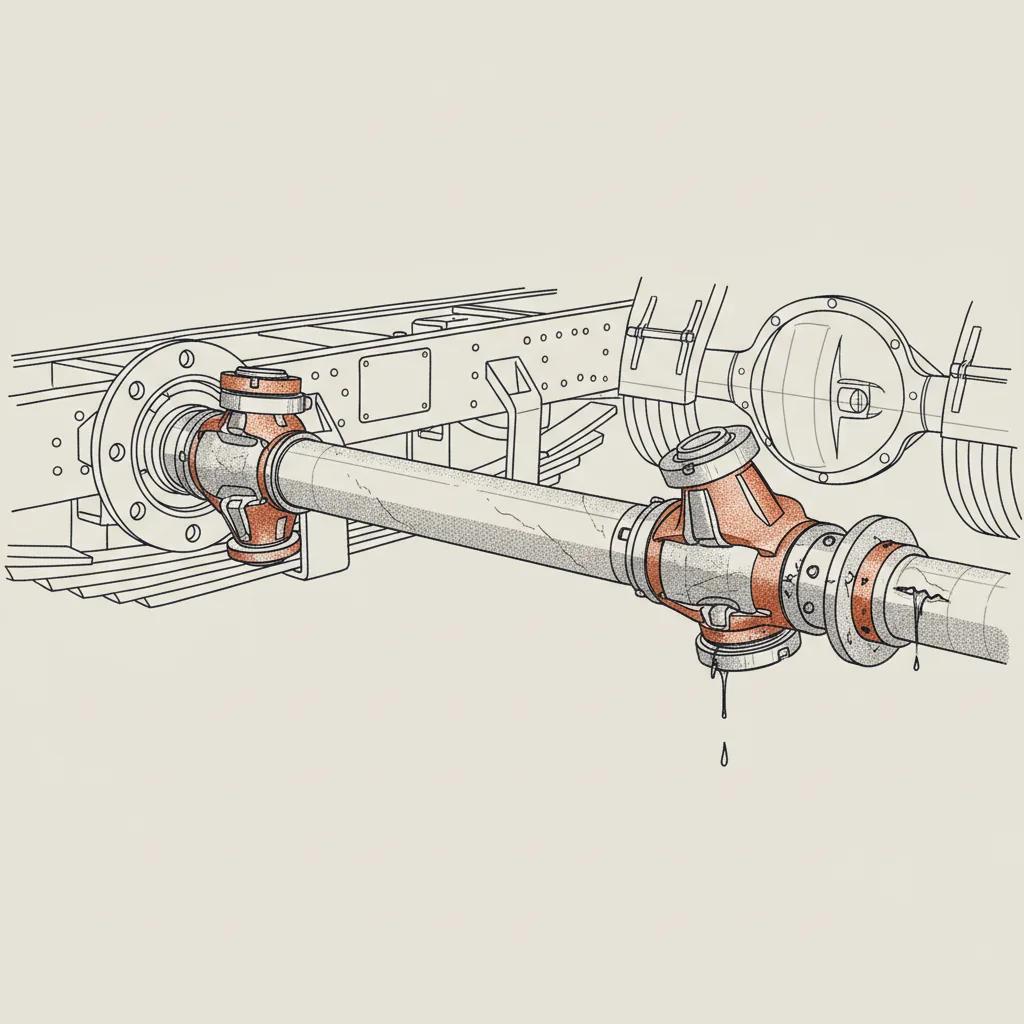
The most common driveshaft failure signs on a semi truck are a vibration that worsens with speed, a clunk or hard "clunk-clunk" when you let out the clutch or shift between drive and reverse, and a squeaking or chirping noise at low speed that goes away as you speed up. These symptoms usually point to worn universal joints (U-joints), a failing center support bearing, or a driveshaft that is out of balance. Catching them early is the difference between a planned repair and a driveshaft separating under load on the highway.
For owner-operators and fleet managers, driveline problems are deceptive. A truck can run for weeks with a marginal U-joint, then fail suddenly. Below is how to read the warning signs, what causes them, and when a vibration means "schedule service" versus "shut it down now."
What the driveshaft and U-joints actually do
The driveshaft transfers torque from the transmission to the rear axle (or, in a tandem setup, through an interaxle driveline). Because the suspension lets the axle move up and down while the transmission stays put, the shaft can't be a rigid bar. U-joints at each end let the shaft flex through that constantly changing angle, and on longer wheelbases a center support bearing holds the midpoint of a two-piece shaft.
Every one of those parts wears. U-joint bearings run on tiny needle rollers packed in grease; the center support bearing rides in a rubber-isolated mount. When the grease breaks down or the rubber perishes, you get play, heat, and noise long before anything breaks outright.
Early driveshaft failure signs to watch for
Most driveline failures announce themselves. Learn to separate the symptoms by when they happen.
Vibration that changes with speed
A driveshaft vibration is felt through the cab floor, the seat, or the shifter, and it typically gets worse as road speed climbs. Causes include:
- A worn U-joint that has developed play in the bearing caps
- An out-of-balance shaft (often after a lost balance weight or a buildup of mud and ice)
- A failing center support bearing
- A bent shaft from road debris or a hard impact
A vibration tied strictly to road speed (not engine RPM) almost always lives in the driveline or the wheels, not the engine.
Clunking on takeoff or when shifting
A distinct clunk when you engage the clutch, pull away from a stop, or shift between forward and reverse is a classic worn-U-joint symptom. The slack in the joint takes up suddenly when torque loads and unloads. A clunk that you can also feel as a thud through the drivetrain should be inspected promptly.
Squeaking or chirping at low speed
A dry U-joint often squeaks or chirps once per driveshaft revolution, so the noise speeds up as you accelerate from a stop and fades at cruising speed. This is the sound of a joint starved for grease, and it's one of the earliest, cheapest-to-fix warnings you'll get.
A rumble or growl from under the truck
A failing center support bearing tends to growl or rumble, and the noise often changes when the driveline loads and unloads. You may also feel a vibration centered under the middle of the truck rather than at the rear.
Visible play or grease slung around
During a walkaround or a pit inspection, grab the shaft and try to rotate and rock it. Any noticeable play in a U-joint, or a ring of slung grease around the joint and surrounding components, signals a joint that's worn or has lost its seal.
What causes driveshaft and U-joint failure
- Missed lubrication. U-joints with grease fittings need regular service. Skipped greasing is the single most common cause of premature U-joint death.
- Worn slip yoke or splines. The slip joint that lets the shaft change length can wear and contribute to clunk and vibration.
- Out-of-balance conditions. Lost balance weights, packed-on mud or ice, or a previous repair done without rebalancing.
- Bent or damaged shaft. Road debris, curb strikes, or driveline contact during an overload.
- Aged center support bearing. The isolating rubber dries out and cracks with age and heat.
- Improper U-joint installation. Over-clamped caps or the wrong series joint can fail early.
When to stop driving
Some driveline noises mean "book it in soon." Others mean "don't move the truck." Err on the side of caution: a driveshaft that drops at speed can puncture the floor, lock a wheel, or damage brake and air lines.
Stop driving and call for service if you notice:
- A sudden, severe vibration that wasn't there before
- A loud bang followed by loss of drive
- Heavy clunking that's clearly worse than yesterday
- Visible, significant play when you rock the shaft by hand
- The shaft visibly hanging, sagging, or contacting the crossmember
A worn U-joint rarely gives much warning between "loose" and "failed." Because a separated driveshaft on a loaded truck is a serious safety and roadside event, a mobile inspection is usually the smarter call than nursing it down the interstate.
How the repair works
Driveline repair starts with the truck safely supported and the shaft inspected for play, runout, and bearing condition. Depending on what's found, the work may involve:
- Replacing worn U-joints and regreasing
- Replacing the center support bearing
- Replacing or rebuilding the slip yoke
- Removing the shaft for balancing or straightening, or replacing a bent shaft
- Checking the transmission output and axle pinion flanges for related wear
Much of this is well suited to on-site work. If your truck is down at a yard, terminal, or on the shoulder along I-5, I-80, CA-99, or US-50, mobile driveshaft repair can often handle U-joint and center bearing replacement without a tow. Because driveline and axle issues frequently travel together, related symptoms such as a separate rear-end whine may also point to differential repair.
How to prevent driveline failures
- Grease U-joints and the slip joint on your preventive-maintenance schedule.
- Have the driveline inspected for play at every PM and DOT inspection.
- Address vibrations early instead of waiting for them to worsen.
- Knock off packed mud and ice that can throw the shaft out of balance.
- After any driveline work, confirm the shaft was rebalanced if it was removed.
FAQ
What does a bad U-joint sound like?
A bad U-joint commonly makes a clunk when you take off from a stop or shift between drive and reverse, and a squeak or chirp at low speed that fades as you accelerate. As it worsens, you'll feel a vibration that grows with road speed.
Can you drive with a bad U-joint?
You should not. A worn U-joint can fail suddenly, allowing the driveshaft to separate at speed, which can damage the truck and create a roadside hazard. If you suspect a bad U-joint, have it inspected before continuing.
Is the vibration from my driveshaft or my tires?
Driveshaft vibration is usually tied to road speed and often comes with a clunk or a noise that changes when the driveline loads. Tire and wheel vibration is also speed-related but typically smoother and steadier. An inspection that checks shaft play, runout, and wheel balance can confirm the source.
How long do U-joints last on a semi?
Lifespan varies widely with load, mileage, and lubrication. Regularly greased U-joints last far longer than neglected ones, which is why missed lubrication is the most common cause of premature failure. Inspect them at every preventive-maintenance interval rather than relying on a fixed mileage.
What causes a driveshaft vibration?
Common causes are worn U-joints, a failing center support bearing, an out-of-balance shaft (often from lost weights or packed mud and ice), worn slip-yoke splines, or a bent shaft. A driveline inspection isolates which one.
Get driveline help across the Sacramento area
If your truck is vibrating, clunking, or squealing from the driveline, don't gamble on the highway. 916 Truck Repair offers 24/7 mobile dispatch across the Sacramento metro and Northern California, including Elk Grove, Stockton, Davis, Woodland, Roseville, and Auburn along the I-5, I-80, CA-99, and US-50 corridors. Call (916) 898-9090 to get a technician headed your way.
 By Vladimir Sardari · Owner & Lead Technician