Home/Blog/Mobile Truck Repair vs. Shop Repair: When to Call for Roadside Service
Blog Post
Mobile TruckRepair vs. Shop Repair: When to Call for Roadside Service
Should you call a mobile mechanic or tow to a shop? The answer turns on repair complexity, location safety, and DOT rules, not just cost. Here's a practical decision framework and a repair-type table for Sacramento drivers running I-80 and I-5.
By Vladimir Sardari · Owner & Lead Technician
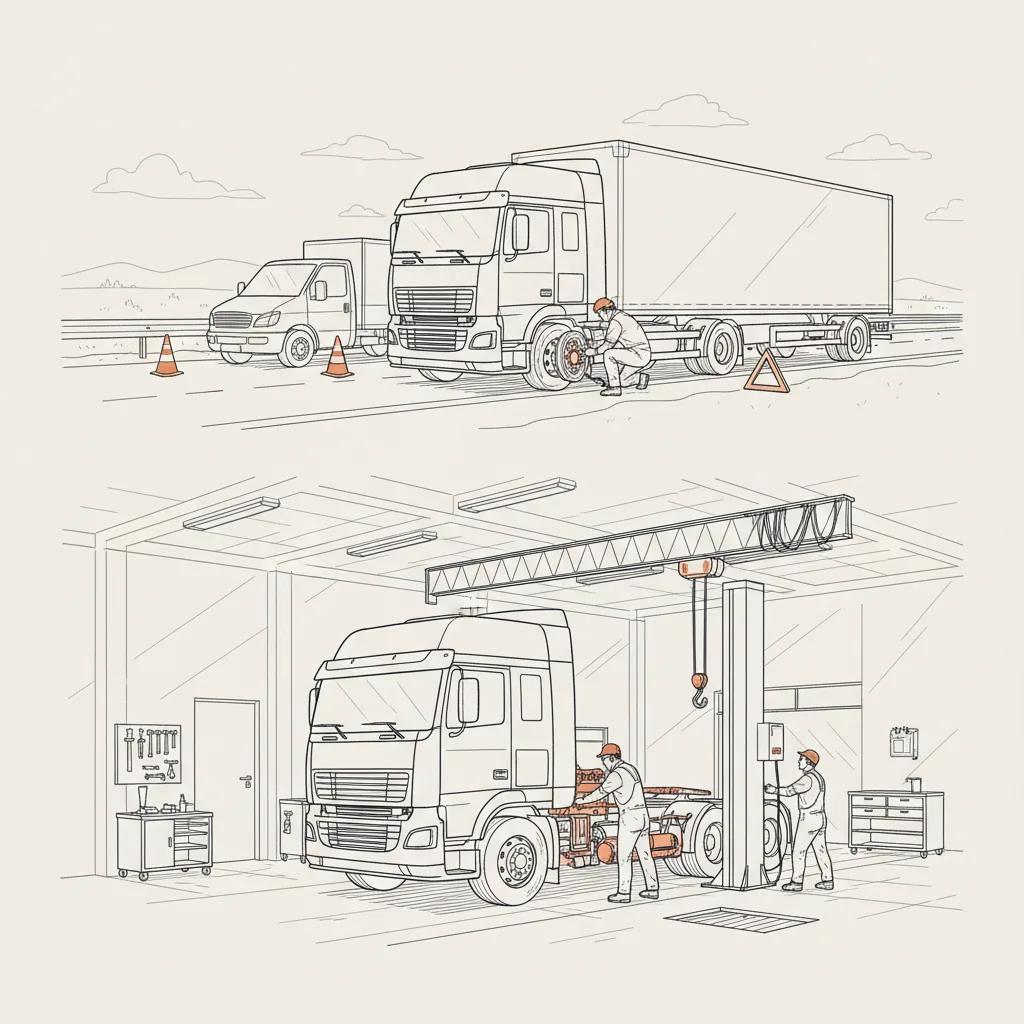
Deciding between mobile repair and a shop comes down to three questions, in this order: Can the job be done safely and correctly where the truck sits? Is the truck legal to move underFMCSArules? And does the failure need a bay, a lift, or a frame rack? If a qualified mobile tech can complete the repair on a safe shoulder or in a yard, mobile usually wins. If the work needs equipment that doesn't fit in a service truck, or the truck shouldn't move at all, the answer changes. This is a fit decision before it's a cost decision.
The Bottom Line
- Match the repair to the setting: jump-starts, air leaks, hoses, belts, sensors, light electrical, and tire or wheel-end work are strong mobile candidates.
- Internal engine, transmission, frame, and alignment work needs a shop with a lift or frame rack.
- Under49 CFR Part 396, a commercial truck must be in safe operating condition before it moves, so legality, not just convenience, drives the call.
- Location and safety matter as much as the part: a blind curve on I-80 changes the math.
How Do You Decide Mobile vs. Shop?
Start with safety and legality, not the invoice. TheU.S. DOTand FMCSA require, under 49 CFR Part 396, that every commercial vehicle be maintained in safe operating condition before it operates. If the defect is one theCVSAout-of-service criteria treat as grounds to pull a truck from service, like inadequate brakes or an unsafe tire, the truck shouldn't be driven to a shop at all. That alone often settles the question.
After safety, weigh four practical factors: repair complexity, parts availability, the truck's location, and your schedule. A roadside-friendly job needs hand tools, a common part, and a safe place to work. A shop job needs a lift, a frame rack, or engine removal. In our experience around Sacramento, the calls that go sideways aren't the complex ones. They're the simple fixes attempted in a terrible spot, like a shoulder on the West Sac interchange at rush hour, where the location, not the repair, is the real problem.
Which Repairs Are Great Candidates for Mobile Service?
Most roadside failures are mobile-friendly because they need parts and tools, not infrastructure. A mobile diesel tech carries diagnostic scanners, air-brake components, batteries, alternators, hoses, belts, and common sensors. FMCSA's own maintenance framework under 49 CFR Part 396 expects routine defects to be corrected promptly, and many of those corrections don't require a bay. If the fix restores safe operating condition where the truck sits, mobile is usually the faster, lower-risk path.
These jobs are typically strong mobile candidates:
Jump-starts and dead batterieson commercial 12-volt or 24-volt systems
Air leaksat fittings, gladhands, or chambers, plus brake-chamber swaps
Hoses, belts, and clamps, including coolant hose and serpentine belt replacement
Sensors and light electrical, like a faulty sensor, wiring fault, or lighting repair
Tire and wheel-end support, including roadside tire service and wheel-end inspection
Air-brake adjustmentsand slack adjuster work within roadside limits
Aftertreatment basics, such as a forced regen or DEF-system fault diagnosis
Citation capsule:Under 49 CFR Part 396, FMCSA requires motor carriers to inspect, repair, and maintain commercial vehicles in safe operating condition, and many corrective repairs, including air-leak fixes, belt and hose replacement, and electrical faults, can be completed roadside by a qualified mobile technician without a shop bay.
Why Mobile Wins for Drivable-but-Failing Trucks
A truck that still runs safely but needs attention before the next load is the clearest mobile case. Think of a sensor fault throwing a derate, a slow air leak, or a charging warning caught early. The U.S. DOT classifies these as conditions to correct before continued operation, and a mobile tech can often clear them in one visit at your yard or terminal. No tow, no shop queue, no extra handling. Here's a point most cost comparisons miss: the best mobile candidate isn't the cheapest repair, it's the one where moving the truck adds risk. Every mile you drive a marginal truck to a shop is a mile a small defect can become a big one.
Which Repairs Usually Need a Shop?
Some repairs need equipment that no service truck carries, full stop. Major internal engine work, full transmission rebuilds, frame straightening, and wheel alignment all require a lift, a transmission jack, or a frame rack. FMCSA and DOT rules still demand the truck reach safe operating condition, but the work itself belongs in a fixed facility. When a mobile tech recommends a tow for these, it's a quality and safety judgment, not a brush-off.
These jobs typically need a shop:
Internal engine work, like cylinder head replacement, crankshaft, or a full overhaul
Transmission rebuilds and clutch replacementon heavy-duty units needing a lift and jack
Frame and axle straightening, which requires a frame rack
Wheel alignment, which needs alignment equipment and a level bay
Deep hydraulic and structural repairson specialized equipment
When a Tow Is the Safer Decision
Tow when the truck isn't legal or safe to move, or when the repair can't be done correctly roadside. A cracked frame, a seized engine, or a brake defect that meets CVSA out-of-service criteria are all stop-and-tow situations. The CVSA standardizes these roadside inspection criteria nationwide, and they exist precisely because certain defects make movement dangerous. Paying for a tow beats driving an unsafe truck into a violation or a crash.
Mobile vs. Shop: A Repair-Type Quick Reference
Use the table below as a starting point, not a guarantee. The right call still depends on the specific truck, the exact failure, and where it happened. As a rule, the more a repair depends on fixed equipment or structural work, the more it leans toward a shop. The more it depends on parts and diagnostics, the more it leans mobile.
Repair type
Mobile or shop?
Why
Jump-start / dead battery
Mobile
Needs jump equipment and a battery, not a bay
Air leak / brake chamber
Mobile
Fittings and chambers swap roadside
Hose, belt, or clamp
Mobile
Common parts, hand tools, quick replacement
Sensor / light electrical
Mobile
Scanner plus part; diagnose on-site
Tire / wheel-end service
Mobile
Roadside tire and hub work with proper gear
Air-brake adjustment
Mobile
Within roadside adjustment limits
Alternator / starter
Mobile
Bolt-on electrical replacement
Cylinder head / engine internal
Shop
Needs lift, engine access, clean bay
Transmission rebuild / clutch
Shop
Needs lift and transmission jack
Frame or axle straightening
Shop
Needs a frame rack
Wheel alignment
Shop
Needs alignment equipment
How Does Your Sacramento Location Change the Call?
Where you break down can override the repair type entirely. A job that's easy in a yard becomes risky on a narrow shoulder in live traffic, and Northern California's corridors are full of bad spots. FMCSA requires emergency warning devices, like reflective triangles, whenever you're stopped on or near the roadway, which tells you how seriously the rules treat roadside exposure. Location decides not just who you call, but where the work can happen.
Tough Roadside Spots on I-80 and I-5
Some stretches near Sacramento make even a simple mobile repair harder. The West Sac interchange where I-80 and I-5 meet has heavy stop-and-go and tight shoulders. The I-80 climb toward Auburn offers fewer safe pull-offs once the grade steepens. The flat I-5 valley run bakes in summer heat that makes both the failure and the repair more punishing. We've found that for a breakdown in a genuinely unsafe spot, the smartest move is sometimes a short tow to a safe area, then a mobile repair there. Mobile versus shop isn't always the only choice. Sometimes it's tow-to-safe-then-mobile.
Yards, Truck Stops, and Terminals
Off the highway, mobile service gets stronger fast. A fleet yard, truck stop, or terminal gives a mobile tech room, light, and time to work safely. For scheduled maintenance, DOT brake inspections, or a non-emergency fault, on-site service avoids a shop trip entirely. The same repair that's marginal on a shoulder is routine in a yard.
Frequently Asked Questions
Can a mobile mechanic handle air brake problems roadside?
Yes, most air brake work is a strong mobile candidate. Air leaks, brake-chamber replacement, and adjustments within limits are routine roadside repairs for a qualified diesel tech. The exception is a brake defect that meets CVSA out-of-service criteria, where the truck shouldn't move and the focus is restoring safe operating condition before it rolls.
When should I tow instead of calling mobile service?
Tow when the truck isn't legal or safe to move, or when the repair needs shop equipment. Cracked frames, seized engines, transmission rebuilds, and any defect under the CVSA out-of-service criteria are tow situations. FMCSA's safe-condition standard under 49 CFR Part 396 means a truck must reach safe operating condition before it travels, even to a shop.
Is mobile repair allowed under DOT and FMCSA rules?
Yes. FMCSA regulations under 49 CFR Part 396 govern the condition of the truck, not where the repair happens. A defect corrected roadside by a qualified technician satisfies the safe-condition requirement just as a shop repair does. What the rules care about is that the truck is safe and legal before it returns to service.
How do I know if my breakdown is mobile-friendly?
Ask whether the fix needs a part and a scanner, or a lift and a frame rack. Jump-starts, air leaks, hoses, belts, sensors, light electrical, and wheel-end work usually need the former. Internal engine, transmission, frame, and alignment work need the latter. When unsure, describe the symptoms and location to dispatch and let them assess.
Making the Call
The mobile-versus-shop decision is really a fit decision: match the repair, the truck's legal status, and the location to the setting that can fix it safely. Routine failures, air leaks, dead batteries, hoses, belts, sensors, light electrical, and wheel-end trouble, usually belong roadside or in a yard. Structural and internal work belongs in a shop with a lift or frame rack. And a bad location on I-80 or I-5 can change a good mobile candidate into a tow-to-safe-first job. Use the framework, not a guess, and you'll keep both your freight and your CSA score intact.
If you're weighing mobile versus a tow somewhere around Sacramento, the I-80, or the I-5, the mobile team at 916 Truck Repair can assess your symptoms and location and tell you honestly which way to go. Get to a safe spot, then call dispatch with your make, model, mile marker, and what you're seeing.
Vladimir Sardari is the owner of Vmore LLC (916 Truck Repair) and has worked in the trucking industry for over 15 years as a diesel mechanic and shop manager. Based in the Sacramento area, he leads the mobile repair team serving local fleets, owner-operators, and drivers across Northern California.
Truck Down? Call 24/7 Dispatch
Mobile truck repair for highway breakdowns, truck stops, fleet yards, docks, and roadside service calls.
 By Vladimir Sardari · Owner & Lead Technician