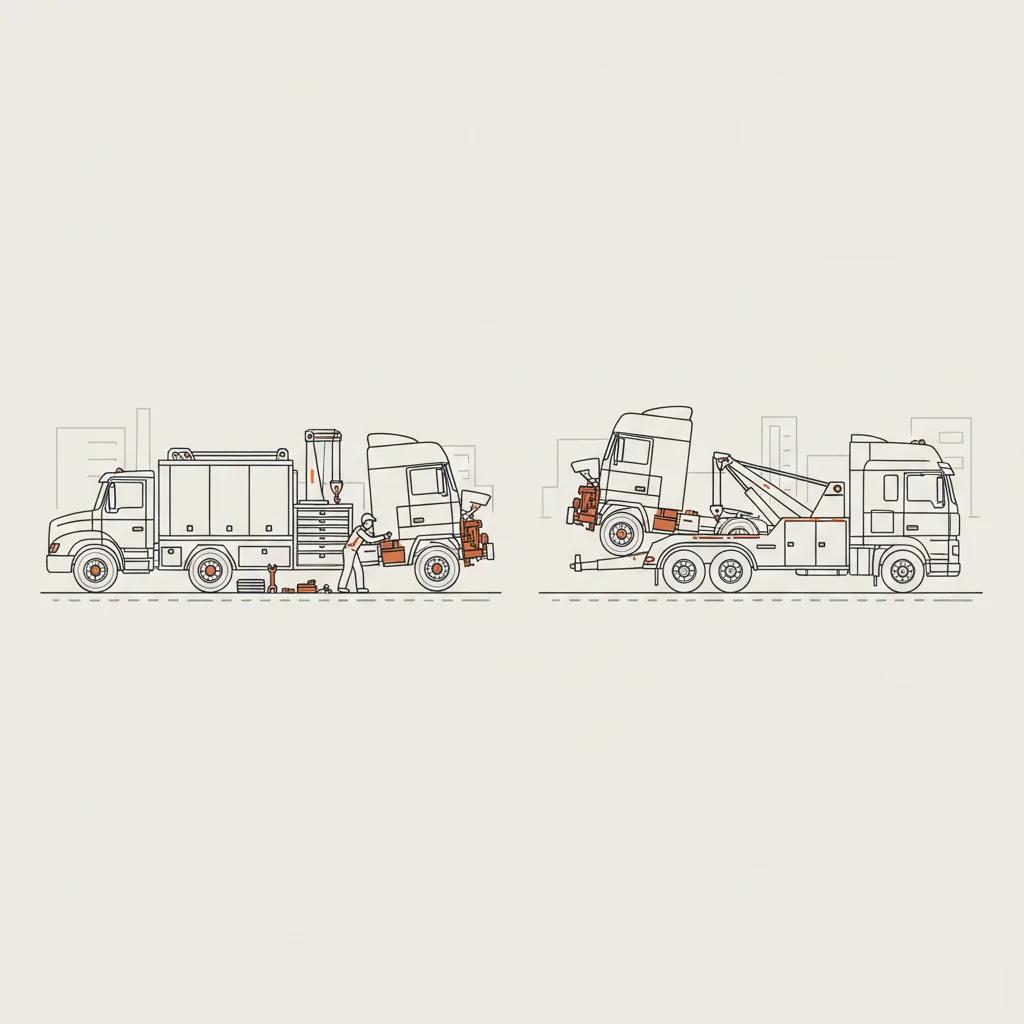
When a commercial truck goes down on the road, mobile repair is usually the lower total cost when the fault can be diagnosed and fixed on-site, because you skip the tow mileage and get rolling sooner. Towing wins when the truck is unsafe to repair where it sits, the failure is too severe for a roadside fix, or the repair needs shop equipment. The right call depends on the failure, the location, and how much each hour of downtime is costing you.
The trap is comparing only the obvious line items. A tow bill and a mobile service call are both visible costs, but the bigger number is often the downtime, lost loads, and detention you never see itemized. This guide breaks down how to think about mobile repair vs tow so you make the cheaper decision over the whole event, not just the first invoice.
The two cost models, side by side
Mobile repair and towing bill in fundamentally different ways. Understanding the structure helps you predict the total before you commit.
What drives mobile repair cost
A mobile or on-site repair is typically built from:
- A service call or dispatch fee to get a technician and a stocked truck to you.
- Labor time on-site, including diagnosis.
- Parts, which may carry a premium if they have to be sourced and delivered to a roadside location.
- Distance to your location, since the provider still has to drive out to you.
The key advantage is that if the repair succeeds roadside, the event ends there. No second stop, no shop intake, no waiting in a queue behind other trucks.
What drives towing cost
Heavy-duty towing for a Class 7 or 8 truck is priced very differently from light-duty towing. Cost factors include:
- A hook-up or base fee.
- Per-mile towing charges, which add up fast for a loaded tractor-trailer.
- Equipment surcharges for heavy wreckers, rotators, or recovery when a truck is off the roadway or jackknifed.
- After-hours, weekend, and accident-recovery premiums.
- Storage or yard fees if the truck sits before it can be worked on.
With towing, the tow itself is only the beginning. You still pay for the repair once the truck reaches a shop, plus any waiting time before the shop can get to it.
The hidden cost most drivers forget: downtime
The invoice you can see is rarely the biggest number. For owner-operators and fleets, downtime is the cost that decides which option was actually cheaper.
Every hour a truck is stopped, you may be absorbing:
- Lost revenue from the load that isn't moving.
- Detention or late-delivery penalties from the shipper or broker.
- Driver pay and hours-of-service clock burning while parked.
- Reload and rescheduling costs if the appointment is missed entirely.
The U.S. Department of Transportation's Federal Motor Carrier Safety Administration (FMCSA) limits most property-carrying drivers to an 11-hour driving window within a 14-hour on-duty period. A breakdown that eats several hours can blow the rest of the day's drive time, turning a mechanical problem into a scheduling problem that costs more than the repair.
This is where mobile repair often pulls ahead on total cost. If a technician can fix the issue where the truck sits, the downtime clock stops sooner than it would if you waited for a tow, rode to a shop, and then waited in the shop's queue.
When mobile repair is the cheaper call
Mobile repair tends to be the lower total-cost option when:
- The failure is diagnosable and repairable on-site, such as air leaks, many electrical and battery faults, light-to-moderate brake work, sensor and DEF/DPF-related faults, hose or belt failures, or a jump start.
- The truck is parked somewhere safe, like a rest area, truck stop, shoulder with room, or a customer yard.
- A shop is far away and the tow mileage would be substantial.
- Time is the constraint, and shaving hours off the event protects a load or the driver's hours.
Many roadside-common problems fall into this category. An air brake repair, a dead-battery heavy-duty jump start, or an electrical fault can frequently be handled where the truck stands, ending the event without a tow at all.
When towing is worth it (and cheaper overall)
Sometimes paying for the tow is the smarter financial decision. Towing is usually the right call when:
- The truck is unsafe to operate or unsafe to work on where it sits, including any out-of-service brake or steering condition.
- The failure is major, such as a catastrophic engine, transmission, or driveline failure that needs shop lifts, presses, or specialized tooling.
- The truck is in a dangerous spot, like a live traffic lane or a position requiring recovery equipment.
- The repair would take so long roadside that a shop bay is genuinely faster and safer.
Paying for a tow to avoid a roadside repair that can't realistically succeed saves money compared with paying for a wasted mobile call and then towing anyway. The most expensive outcome is doing both in the wrong order.
How to decide in the moment
When you're stopped on the shoulder, a quick framework keeps the decision rational:
- Is it safe? If the truck or the work location is unsafe, lean toward a tow and recovery.
- Is it diagnosable roadside? Faults with clear symptoms or codes are good mobile candidates. Unknown, intermittent, or catastrophic failures may need a shop.
- How far is the nearest capable shop? The longer the tow, the more mobile repair's no-mileage advantage matters.
- What's the load worth right now? A time-sensitive or high-penalty load raises the value of the faster option, which is often mobile.
A good mobile provider will help triage this over the phone before anyone is dispatched, so you don't pay for the wrong service. That phone diagnosis is part of why mobile truck repair and roadside truck repair can be cost-effective: the goal is to send the right help once, not to guess.
FAQ
Is mobile truck repair cheaper than towing?
Often, but not always. When the problem can be fixed on-site, mobile repair usually costs less in total because you avoid heavy-duty tow mileage and reduce downtime. When the truck is unsafe or the failure needs shop equipment, towing is the cheaper path overall because a roadside attempt would fail anyway.
Why is heavy-duty towing so expensive?
Heavy-duty towing requires larger, costlier wreckers and trained operators. Bills typically combine a hook-up fee with per-mile charges, and they can include surcharges for recovery, after-hours work, and storage. For a loaded tractor-trailer, the per-mile portion alone can dominate the cost.
What truck problems can a mobile technician fix on-site?
Many roadside-common issues, including air leaks, a range of electrical and battery faults, jump starts, hose and belt failures, certain brake repairs, and many sensor or emissions-system faults. Major internal engine, transmission, or driveline failures usually need a shop.
How does downtime factor into the cost comparison?
Downtime is frequently the largest cost in a breakdown. Lost load revenue, detention penalties, driver pay, and burned hours-of-service time can exceed both the repair and the tow. The option that gets the truck moving sooner is often the cheapest once downtime is counted.
Should I tow first and diagnose later?
Usually not. Towing before anyone has assessed the failure can mean paying for a tow you didn't need. A quick phone triage with a mobile repair provider can determine whether a roadside fix is realistic before you commit to either option.
If you're weighing mobile repair against a tow anywhere in the Sacramento metro or along the I-5, I-80, CA-99, and US-50 corridors, call 916 Truck Repair at (916) 898-9090. Our 24/7 mobile dispatch can help you decide on the phone and get the right help moving across Sacramento and Northern California.
 By Vladimir Sardari · Owner & Lead Technician