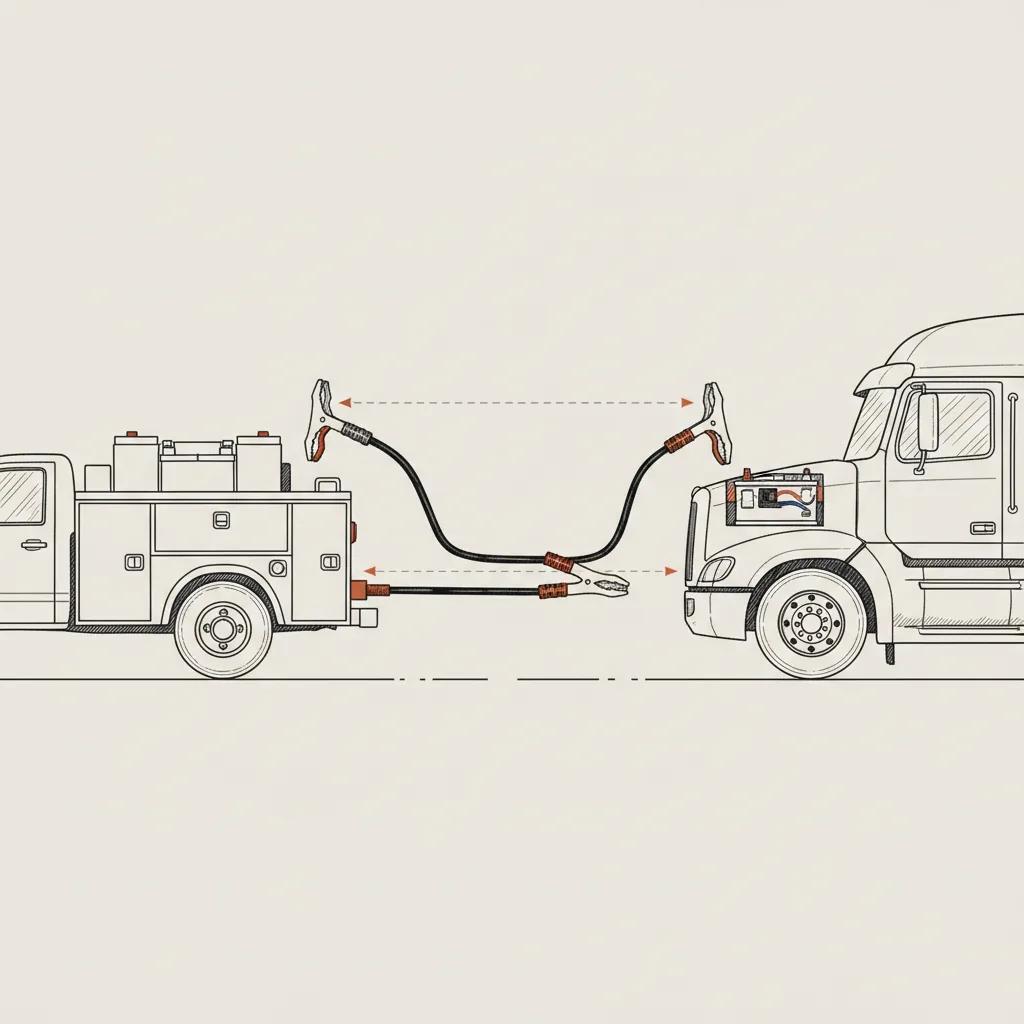
A heavy-duty jump start makes sense when a truck's batteries are simply discharged, from lights left on, a long key-on accessory drain, or sitting in the cold, and the rest of the electrical system is healthy. Call for professional help instead when the truck won't crank even after a proper jump, when batteries are visibly damaged or leaking, when the engine cranks but won't stay running on its own, or when you're not equipped to jump a 12- or 24-volt heavy truck safely. The goal of a jump is to get the engine running on its own power; if it won't, the real problem is usually batteries, cables, the starter, or the charging system, and that needs diagnosis, not another jump.
A discharged battery is one of the most common reasons a commercial truck won't start, and a heavy-duty jump start is the fastest way back on the road when that's all that's wrong. But jumping a semi is not the same as jumping a car. Heavy trucks carry multiple high-capacity batteries, large cable runs, and far higher cranking demands, so the wrong approach either fails or causes damage.
When a Jump Start Is the Right Call
A jump start is the correct fix when the batteries are merely flat and everything else works. Common scenarios:
- Lights or accessories left on overnight drained the bank while the truck sat.
- Cold weather sharply reduced available cranking power on batteries that were already aging.
- Long key-on idle time running the HVAC, inverter, or APU loads pulled the batteries down without the engine charging them.
- A truck that sat for days or weeks with a slow parasitic draw bleeding the batteries below cranking voltage.
In these cases the batteries hold a charge once the engine runs and the alternator brings them back up. The tell is simple: after a good jump, the engine starts, runs steady, and the truck behaves normally. If that happens, you were dealing with a discharge, not a failure.
When to Stop Jumping and Call for Help
Repeated jumps are a warning sign, not a solution. Call for mobile diagnosis instead of jumping again when:
- The truck won't crank even with a strong jump. That points to a starter, a heavy voltage drop in the cables or grounds, or a dead cell that won't accept current. More boost won't fix a bad starter or a corroded connection.
- The engine cranks but won't keep running once you remove the jump source. That usually means the charging system, often the alternator, isn't keeping the truck alive on its own.
- You need a jump every morning. A truck that dies overnight repeatedly has a parasitic draw, a failing battery bank, or a charging fault that has to be found and fixed.
- Batteries are swollen, cracked, leaking, or smell of sulfur. Damaged batteries can vent hydrogen gas and should not be jumped. They need replacement.
- You're not equipped to do it safely. Heavy trucks may run 12-volt or 24-volt systems, and connecting boost gear incorrectly can damage electronics or injure you.
When a jump doesn't hold, the underlying issue is electrical and needs to be traced. Telling a discharged battery from a failing alternator or a bad starter is exactly the kind of call that a technician with a meter can settle in minutes.
How a Heavy-Duty Jump Start Works (and Why It's Different)
A car booster pack will not reliably turn over a loaded diesel. Heavy trucks need a high-output jump source, heavy-gauge cables rated for the current, and correct connections to deliver the amperage a big starter pulls.
12-volt vs 24-volt systems
Most on-highway trucks in North America run a 12-volt system with several batteries wired in parallel for capacity. Some equipment uses 24-volt or series-parallel arrangements. Connecting a 12-volt boost to a 24-volt system, or vice versa, can fry electronics. Knowing the system before connecting anything matters.
Connection order and safety
The basics still apply, scaled up. Connect to a fully charged source, attach positive to the dead positive, then ground the booster to a clean engine ground or frame point away from the battery, not directly to the dead negative terminal, to keep any spark away from battery gases. Reverse the order to disconnect. Keep cables clear of belts and the fan, and never jump a frozen, cracked, or leaking battery.
Why repeated jumping hides the real problem
Each jump only masks the symptom. If the charging system is weak, the alternator drains right back down and you're stranded again, often somewhere worse. A proper diagnosis after the first or second jump saves a repeat breakdown.
What to Check Before You Call
A few quick observations help you and any technician zero in fast:
- Look at the battery terminals and ground straps for corrosion, looseness, or a green/white buildup that chokes current.
- Note whether the truck does nothing, clicks once, or cranks slowly, since each points to a different cause.
- Recall what happened before, lights left on, cold snap, long idle, or the truck simply sat.
- Check for obvious battery damage: swelling, cracks, leaks, or smell.
- Avoid grinding the starter with endless cranking, which overheats it and deepens the discharge.
If the truck jumps and runs normally, you likely just needed a boost and a charge. If it won't take a jump, won't stay running, or needs one daily, the fix is diagnosis and repair, not more boost.
Jump Start vs Battery vs Alternator: Sorting the Symptom
The quick way to think about it: a jump start addresses a discharged battery, battery service addresses a battery that no longer holds a charge, and charging-system work addresses a truck that won't stay running on its own. A boost that fixes the truck means discharge. A boost that the truck immediately drains again means the charging system. A boost that does nothing means the starter, cables, grounds, or a dead bank. Each path leads somewhere different, which is why a real diagnosis beats guessing. If a jump gets you going but you suspect the bank or the charging side, our alternator repair and electrical wiring repair services trace the root cause so it doesn't strand you again.
FAQ
When should I call for a heavy-duty jump start instead of jumping it myself?
Call when you don't have a high-output jump source and heavy-gauge cables rated for a commercial truck, when you're unsure whether the system is 12-volt or 24-volt, or when the batteries look damaged. A car booster pack usually can't turn over a loaded diesel, and an incorrect connection can damage electronics.
Why does my truck need a jump start every morning?
A truck that goes dead overnight repeatedly has a real fault, not just a discharge. The usual causes are a parasitic electrical draw, a failing battery that no longer holds a charge, or a charging-system problem like a weak alternator. It needs diagnosis; jumping it daily only delays the breakdown.
Is it the battery or the alternator if a jump start doesn't last?
If the truck starts on a jump but dies again once you disconnect, the charging system, often the alternator, is the likely culprit because it isn't keeping the truck running on its own. If the truck won't take a jump at all, suspect the batteries, cables, grounds, or starter instead.
Can you jump start a 24-volt truck with a 12-volt source?
No. Matching voltage matters. Connecting a 12-volt boost to a 24-volt system, or the reverse, can damage sensitive electronics. Confirm the truck's system voltage before connecting any jump source, which is one reason a heavy-duty jump start is best handled with the right equipment.
Is it safe to jump a swollen or leaking truck battery?
No. A swollen, cracked, or leaking battery, or one that smells of sulfur, can vent hydrogen gas and should not be jumped. It needs to be replaced. Keep sparks away from any battery and ground the booster to the frame or a clean engine ground rather than the dead negative terminal.
Get Rolling Again
A dead bank can strand a loaded truck anywhere along I-5, I-80, US-50, or CA-99. 916 Truck Repair provides mobile, on-site heavy-duty jump start and electrical diagnosis across the Sacramento metro and Northern California, including Elk Grove, Stockton, Davis, Woodland, Roseville, and Auburn. Call (916) 898-9090 for 24/7 mobile dispatch and get a technician to your truck.
 By Vladimir Sardari · Owner & Lead Technician