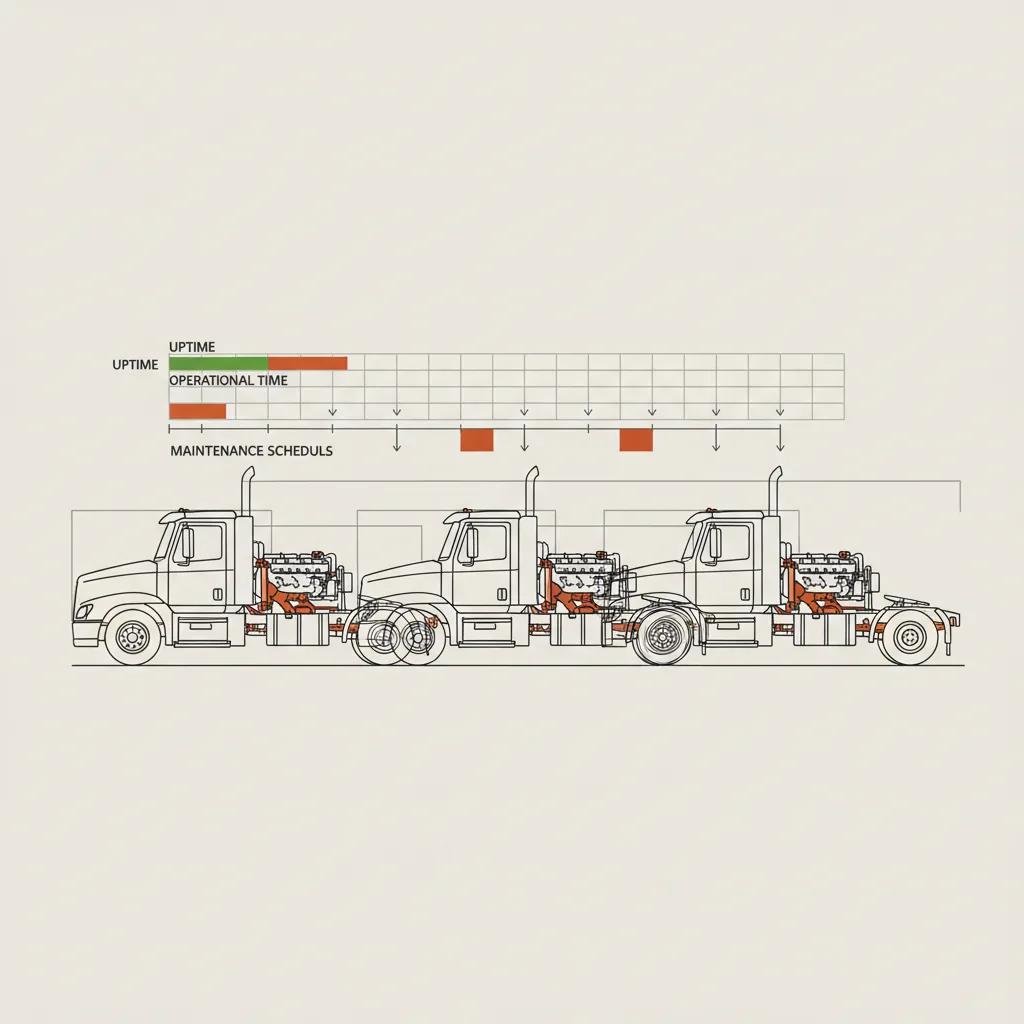
The fastest way to reduce fleet downtime is to catch failures before they strand a truck and to shorten the repair window when something does break. That means running mileage-based preventive maintenance, watching dash fault codes and telematics for early warnings, enforcing thorough pre-trip inspections, and using mobile repair so trucks get fixed where they sit instead of waiting for a tow and a shop bay. Fleets that combine prevention with rapid response keep more units earning revenue and fewer parked on the shoulder.
Downtime is one of the most expensive problems in trucking because a parked truck still carries fixed costs while earning nothing. A roadside breakdown adds towing, missed loads, detention, and emergency diagnostics on top of the actual repair. The good news: most downtime is predictable and preventable with a disciplined process. Below are the strategies that move the needle most for owner-operators, fleet managers, and dispatchers.
Build a Preventive Maintenance Program That Actually Runs
Preventive maintenance (PM) is the single biggest lever you have to reduce fleet downtime. Unplanned roadside repairs cost far more in time and money than the same work scheduled in advance. The goal is to convert surprise failures into planned service.
- Set intervals by mileage and engine hours, not by the calendar alone. Long-haul and local-delivery trucks wear differently.
- Track each unit individually. A spreadsheet or fleet maintenance software should flag oil changes, filter service, brake checks, and DOT periodic inspections before they come due.
- Standardize the PM checklist so every technician inspects the same wear points: brakes, tires, fluids, belts, hoses, air system, charging system, and emissions components.
- Bundle the work. When a truck is already down for an oil service, knock out small items you would otherwise let slide.
The U.S. Department of Transportation, throughFMCSA, requires that commercial motor vehicles be systematically inspected, repaired, and maintained, and that records be kept. A documented PM program both reduces downtime and supports compliance.
Use Fault Codes and Telematics as an Early Warning System
Modern diesel trucks tell you when something is wrong long before it becomes a breakdown. Ignoring a check-engine light or a low-severity fault is how a minor sensor issue becomes a derate on the side of the highway.
- Read codes early. A flashing warning lamp or active fault should be diagnosed promptly, not at the next scheduled PM.
- Watch emissions warnings closely. DPF and DEF system warnings can escalate to an engine derate or limp mode that drops the truck to a crawl. TheEPArequires these emissions controls to function, so a warning light is both a reliability and a compliance issue.
- Trend the data. Telematics that log fuel economy, coolant temperature, and recurring codes help you spot a developing problem across the fleet, not just one truck.
Catching a fault while the truck is still in service lets you schedule the fix on your terms instead of paying for an emergency call.
Strengthen Driver Inspections
Drivers are your first line of defense against downtime. FMCSA requires a driver vehicle inspection report (DVIR) when defects are found, and a real pre-trip inspection catches problems while the truck is still in the yard.
- Train for quality, not speed. Drivers should check tires and tread depth, lights, air pressure buildup, brake function, leaks, and load securement every day.
- Make reporting frictionless. If it is easy to log a defect, drivers will report the small stuff before it grows.
- Close the loop. A reported defect that never gets scheduled defeats the purpose. Tie DVIRs directly into your maintenance queue.
Shorten the Repair Window When a Truck Goes Down
Prevention will not catch everything, so the second half of reducing downtime is repairing faster when a failure happens. The longer a truck waits for service, the bigger the loss.
Use mobile and on-site repair
Towing a heavy truck to a shop and waiting for an open bay can cost a full day or more. On-site service removes that delay by bringing the technician to the truck.
- A mobile truck repair unit can handle many roadside and yard repairs where the truck sits, eliminating the tow.
- For fleets, scheduled on-site fleet repair lets multiple units get serviced at your terminal, so trucks come down on a plan instead of one breakdown at a time.
Keep common parts and a vendor relationship ready
- Stock or pre-source high-failure items: belts, filters, sensors, air lines, and lamps.
- Establish a repair partner before you need one. Sorting out who to call during a breakdown wastes the most valuable hours.
What Drives Repair Cost and Downtime
You cannot control every variable, but understanding the cost factors helps you reduce both. General factors that affect downtime and repair expense include:
- Severity and location of the failure (yard vs. remote highway breakdown).
- Whether a tow is required before any work can begin.
- Parts availability for the specific make and model.
- Time of day, since after-hours emergencies are more disruptive than planned service.
- How early the problem was caught, which is why prevention pays off.
These are general industry factors, not a quote. Costs vary by truck, fault, and circumstances.
FAQ
What is the biggest cause of fleet downtime?
Unplanned roadside breakdowns and emissions or engine faults that escalate into derates are among the most disruptive. Many trace back to deferred maintenance or ignored fault codes, which is why a disciplined PM program is the most effective prevention.
How does preventive maintenance reduce downtime?
Preventive maintenance converts unpredictable failures into scheduled service. By replacing wear items and catching developing problems during planned PM, you avoid emergency repairs, towing, and missed loads. FMCSA also requires systematic inspection and maintenance of commercial vehicles.
Does mobile repair really cut downtime?
Yes. Mobile and on-site repair eliminate the tow and the wait for an open shop bay by bringing the technician to the truck. For fleets, scheduled on-site service lets several units be maintained at one location with less disruption.
How often should fleet trucks be inspected?
Drivers should perform a pre-trip inspection every day, and defects must be reported through a DVIR per FMCSA rules. Beyond daily checks, set PM intervals based on mileage and engine hours, and complete the federally required periodic (annual) inspection.
Get Help Reducing Your Fleet Downtime
When a truck goes down, fast service keeps your operation moving. Call 916 Truck Repair at (916) 898-9090 for 24/7 mobile dispatch across Sacramento and Northern California, including the I-5, I-80, CA-99, and US-50 corridors and cities like Elk Grove, Stockton, Roseville, and Auburn.
 By Vladimir Sardari · Owner & Lead Technician