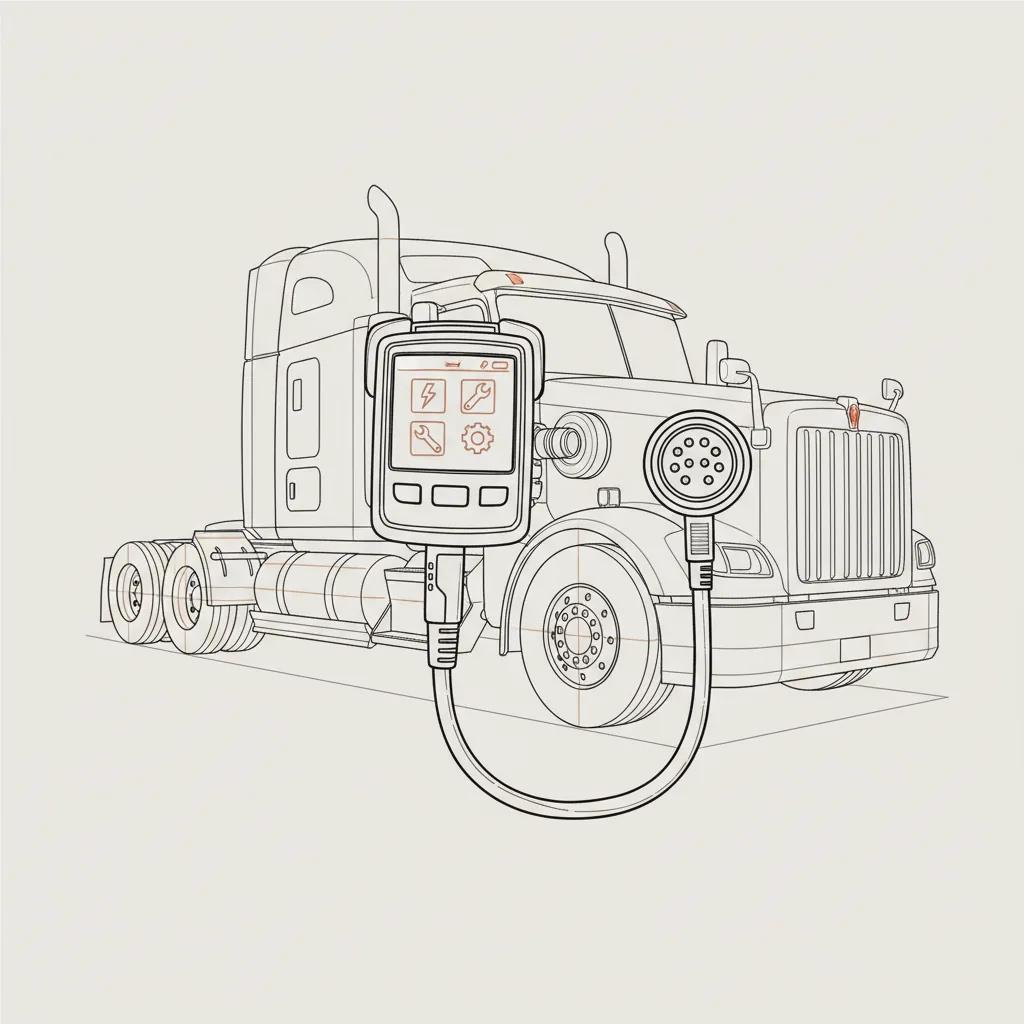
A diesel fault code is a stored message from the truck's onboard computers that identifies what failed and how. Modern heavy trucks use the SAE J1939 standard, where each fault pairs a Suspect Parameter Number (SPN) that names the affected component or system with a Failure Mode Identifier (FMI) that describes the type of problem, such as an open circuit, a value too high, or a sensor reading out of range. Reading both numbers together tells you what to check before you ever pick up a wrench.
For fleet owners and owner-operators, fault codes are the difference between guessing and diagnosing. A blinking check-engine lamp on I-5 outside Stockton means something specific, and knowing how to interpret diesel fault codes helps you decide whether to keep rolling, slow down, or shut down and call for help.
What a Diesel Fault Code Actually Tells You
Every modern diesel truck runs multiple electronic control units (ECUs): the engine controller, the aftertreatment (DPF/DEF) controller, the ABS module, the transmission controller, and others. When a sensor reading or system behavior falls outside expected limits, the responsible ECU logs a fault and, depending on severity, turns on a dash lamp.
The SAE J1939 protocol is the common language these controllers use on Class 6-8 trucks. A J1939 fault has a few key parts:
- SPN (Suspect Parameter Number): identifies the system or component, for example a specific temperature sensor, the DEF dosing valve, or a turbo actuator.
- FMI (Failure Mode Identifier): describes the failure type, such as voltage above normal, voltage below normal, data erratic, or no signal.
- Occurrence count: how many times the fault has been logged, which helps separate a one-time glitch from a recurring problem.
- Lamp status: whether the fault triggered the amber warning lamp, the red stop lamp, or the malfunction indicator lamp.
Reading the SPN and FMI together narrows the cause quickly. The same SPN with a different FMI can point to a wiring issue versus a failed component, so both numbers matter.
OBD codes vs. J1939 codes
Light-duty and many medium-duty trucks also report generic OBD-II "P-codes," while heavy commercial trucks lean on J1939 SPN/FMI codes, sometimes with proprietary manufacturer codes layered on top. Note which format you are reading, because the same problem can appear under different numbers depending on the tool and the truck.
Active vs. Stored (Inactive) Codes
Not every code on the screen is a current problem. Diagnostic tools separate faults into two groups:
- Active codes are happening right now. The condition is present and the ECU is reporting it live. These are your priority.
- Stored or inactive codes were logged earlier but are not currently active. They form a history that can reveal an intermittent fault, like a chafed wire that only shorts on rough pavement.
A single stored code with one occurrence may be nothing. A stored code with a high occurrence count, or one that keeps returning after you clear it, means the underlying fault is real and recurring. Clearing codes without fixing the cause just hides the symptom until it comes back, often at a worse time.
How Fleets Read Fault Codes
There are several ways to pull codes, from simple to detailed:
- Dash and odometer menus: Many trucks display active fault codes through the driver information display. This is enough to capture the SPN/FMI on the roadside.
- Telematics and ELD platforms: Most fleet telematics systems read the J1939 bus and report fault codes to a dashboard in near real time, often with severity flags. This lets a dispatcher see a developing problem before the driver calls in.
- Handheld and laptop scan tools: A code reader or a manufacturer diagnostic application connects to the 9-pin or 16-pin diagnostic connector and shows full fault data, freeze-frame parameters, and live sensor values. This is where real diagnosis happens.
A good practice for any fleet is to record the exact code, whether it is active or stored, the occurrence count, and what the truck was doing when it appeared. That information saves diagnostic time when a technician arrives.
Which Fault Codes Mean Stop Now
The dash lamp color is your first guide to urgency. In general terms across heavy trucks:
- Amber check-engine / malfunction lamp: a fault is present and needs attention, but the truck is usually drivable. Schedule service soon and monitor gauges.
- Red stop-engine lamp: the ECU has detected a condition serious enough to risk engine damage, such as low oil pressure, high coolant temperature, or low coolant level. Safely pull over and shut down.
- Flashing lamps: a flashing warning generally signals a more urgent version of the same fault and should be treated seriously.
Emissions-related faults deserve special attention. Codes tied to the DPF, DEF, or SCR system can trigger an engine derate, where the ECU progressively limits power and speed to protect the aftertreatment and enforce compliance. A derate that starts as a minor power reduction can escalate to a crawl if the underlying fault is ignored, so emissions codes are not something to drive on indefinitely.
When a red lamp comes on, when power drops sharply, or when oil pressure, coolant temperature, or DEF warnings appear, the safe move is to stop and call for diesel engine repair service rather than push the truck and risk a far larger bill.
Common Fault Code Categories
While exact codes vary by engine maker, most faults fall into a handful of categories:
- Sensor and circuit faults: open circuits, shorts, and out-of-range readings, often from a failed sensor, corroded connector, or chafed harness.
- Aftertreatment faults: DPF pressure or temperature issues, DEF quality or dosing problems, and SCR efficiency faults.
- Air and boost faults: turbo actuator, boost pressure, or charge-air problems.
- Fuel system faults: rail pressure, injector, or fuel temperature codes.
- Electrical and charging faults: low system voltage and battery or alternator issues that can cascade into multiple unrelated-looking codes.
That last point matters: a weak battery or charging fault can throw a cluster of codes across several modules at once. Chasing each code individually wastes time when the real fix is the power supply. A technician reads the full picture before condemning parts.
When to Call a Mobile Technician
A code reader tells you what failed, but not always why. Calling for service makes sense when:
- A red stop lamp is on or the engine is in derate.
- The same code keeps returning after being cleared.
- Multiple codes appear at once and the cause is not obvious.
- The code points to the fuel, turbo, or aftertreatment system, where misdiagnosis is expensive.
- The truck is loaded and on a schedule, and downtime risk outweighs a roadside attempt.
A mobile diesel technician can connect a full diagnostic tool on site, read freeze-frame data, test the suspect circuit, and confirm the cause before replacing anything. For trucks down along the I-5, I-80, CA-99, or US-50 corridors, mobile truck repair brings the diagnostic equipment to the truck instead of waiting on a tow.
FAQ
What is an SPN and FMI in a diesel fault code?
Under the SAE J1939 standard used on heavy trucks, the SPN (Suspect Parameter Number) identifies the affected component or system, and the FMI (Failure Mode Identifier) describes the type of failure, such as a short, an open circuit, or a value out of range. Read together, they point to the likely cause.
Can I keep driving with a check-engine light on?
An amber check-engine lamp usually means the truck is drivable but needs attention soon, while a red stop-engine lamp signals a serious fault and means you should safely shut down. Always watch oil pressure, coolant temperature, and DEF gauges, and have the code diagnosed promptly.
Is it safe to clear fault codes myself?
Clearing a code does not fix the underlying problem. If the fault is still present, an active code will return, and clearing it first can erase freeze-frame data a technician needs. It is better to record the code and have the cause diagnosed before clearing anything.
Why does my truck show several fault codes at once?
Multiple codes can come from one root cause. Low system voltage from a weak battery or failing alternator, for example, can trigger faults across several control modules at the same time. A full diagnostic identifies the underlying issue instead of treating each code separately.
What does an engine derate from a fault code mean?
A derate is when the engine control unit limits power or speed to protect the engine or aftertreatment system, often in response to emissions-related faults involving the DPF, DEF, or SCR. Ignoring it can lead to a more severe derate, so the fault should be diagnosed quickly.
If your truck is throwing fault codes, in derate, or sitting with a warning lamp anywhere across the Sacramento metro or Northern California, call 916 Truck Repair at (916) 898-9090 for 24/7 mobile dispatch. We bring the diagnostic tools and repairs to your truck along the I-5, I-80, CA-99, and US-50 corridors and in Elk Grove, Stockton, Davis, Woodland, Roseville, and Auburn.
 By Vladimir Sardari · Owner & Lead Technician